Books and Looks
23 hours ago
I am not making much progress with my resolution to blog more this year…perhaps I can alter my habits by January, a more traditional time for resolutions.
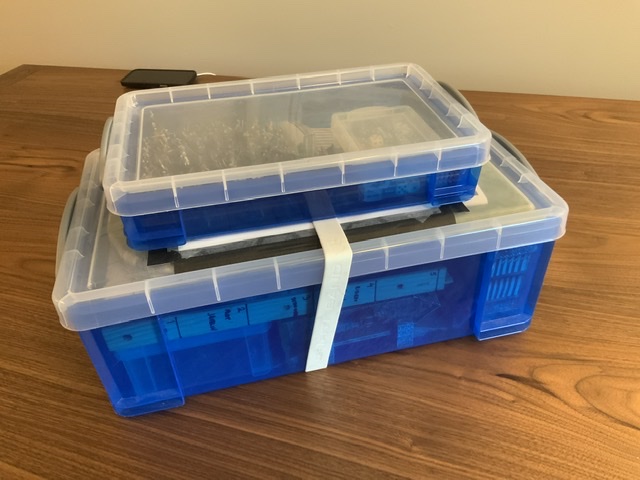
At any rate, I have a list of rules and periods I have been wanting to try, and I had some time this past Sunday to check another one off the list. At some point during the pandemic, I bought some magnetic movement stands from Litko, sized for units in One Hour Wargames. My intention was to use them to temporarily mount stands or figures from other projects; I should be able to do some sort of ancients, Dark Ages, Pike and Shot, and Horse and Musket. First up (finally!) was Horse and Musket. I randomly selected a scenario from the book, which turned out to be Scenario 1, Pitched Battle, based on Ceresole in 1544. I used figures from my NQSYW collection to field a Red (League) army of 3 infantry, 1 skirmisher, and 2 cavalry aganst a Blue (Coalition) army of 3 infantry, 2 artillery and 1 cavalry.

While not the best idea, I looked at that and decided that the League either had to withdraw or attack, since they would otherwise be worn down by artillery fire without being able to respond. The 3x3 table doesn’t allow a lot of maneuver, and the horse and musket rules give infantry a 12” range, so it was a die rolling contest for the most part. The game ended on turn 11 with a charge by the Coalition dragoons scattering the last League infantry.


A lot has been going on since I last blogged, both in life and in hobby activities.
My younger son has returned to this part of the world, so, with both sons relatively nearby, we are looking forward to some family wargmaing time. However, moving just before the holidays has meant that everyone has a lot of activity already scheduled. We did manage to get a good game in on the margins of the Thanksgiving feasting last week:

We played the Battle of Montebello scenario from Neil Thomas’s Wargaming Nineteenth Century Europe. There’s a full report on elder son Norman’s blog.
I managed to get my limited French Revolution collection on the table for a solo game recently.
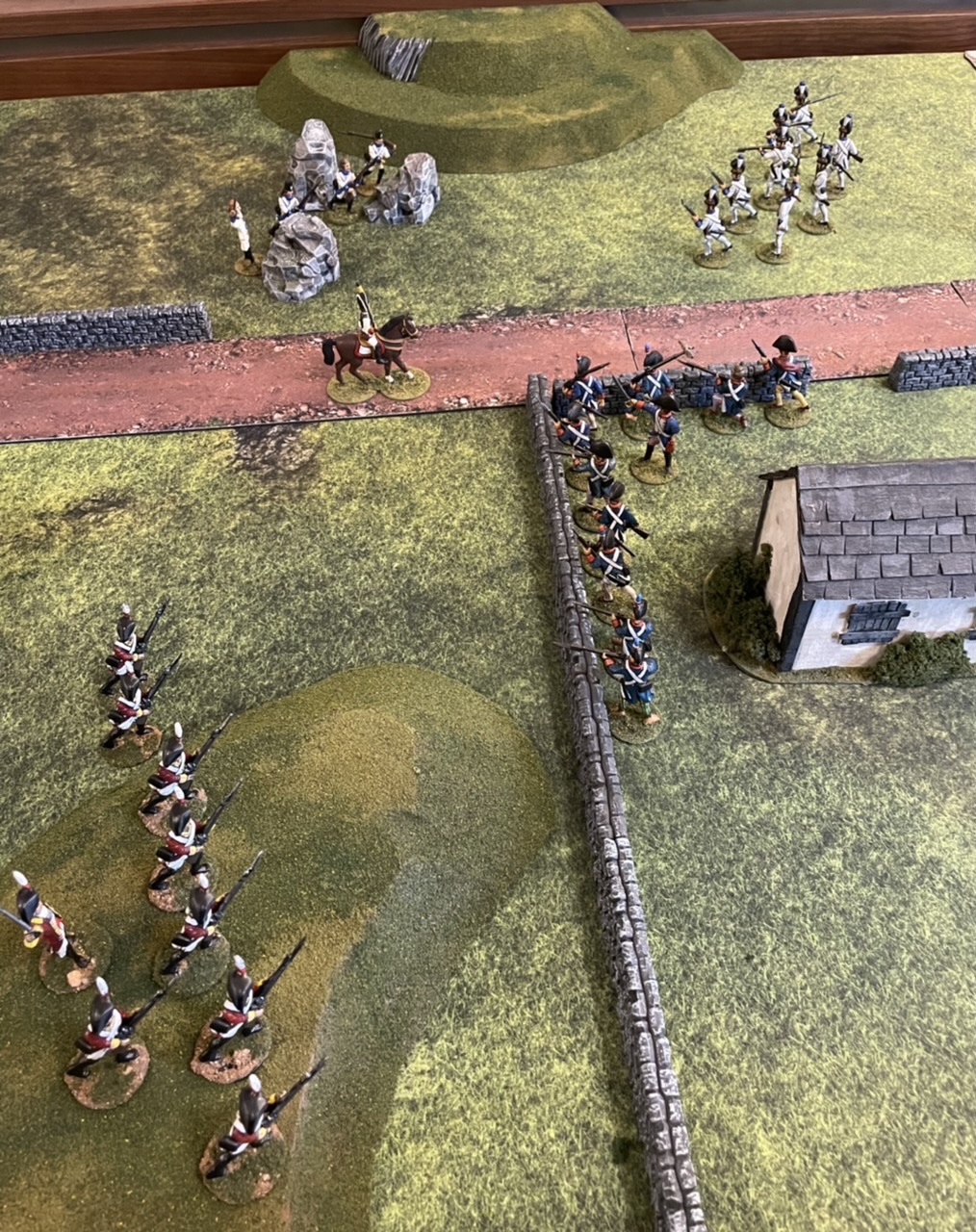

This was in service of a playtest of some new horse and musket large skirmish rules currently in development, so I won’t comment on that part of it, but it was good to see these figures on the table. While Norman ran a game with them at an HMGS convention in the mid-teens, I personally haven’t had them on the table since 2009. Until November, they had been my second longest unplayed project, topped only by my neglected little 6mm Spanish Civil War collection, which was last on the table in 2005. I plan to bring out the French and Indian War figures (last played in 2016 when Ross came down for Fall In) for the next playtest, but with the holidays, that might be a few weeks yet.
A few weeks ago I visited Days of Knights, my friendly local game store, and was surprised to find that the latest release in Osprey’s series of role playing games was a “clockpunk” Italian Renaissance game, set in a 1510 that included advanced Leonardo da Vinci technology.

Now, as it happens, I have a 40mm 16th century toy soldier project already in hand, and I am currently the possessor of some Leonardo-type machines built by my friend Chris Palmer back in the late 1990s. I dug them out to take a look, and found them all to still be in good shape:

We used these for a year or so and then got distracted (as is so often the case). Chris dug out some print pictures of them in action back around 1998. Here’s a sample:

I have been trying out the “slapchop” painting technique on some old Hinchliffe Byzantines. That deserves a separate report later…


There was a brief discussion this past week over on the Reaper Forums about solo games. This reminded me that I had left a battle pending in the Northlands campaign. Since the last Northlands related game I played was a skirmish game back in June, that probably means that it has been pending since some time in July or August.
So, I decided to set it up. I had been avoiding it because it looked like a blow-out; one kingdom’s army had advanced into another’s territory, and, due to bad intelligence (as provided by occasional die rolls to assist in decision making along the way), was attempting to attack without realizing that they were outnumbered about 2:3. But, having been reminded, I thought that I would like to resolve it, so as to clear the way for something more interesting down the line.
I decided to roll at random for one of the 30 scenarios in Neil Thomas’s One Hour Wargames book, and got scenario 7, “Flank Attack”. Not only that, but the dice decreed that the larger force was the ambusher. I thought, “well, that’ll be that”, but then noticed one little peculiarity in the line up. The smaller force (the King of Darmis and his army) had a Magician unit, and the larger force (the King of Verdance and his army) was led by a Hero (i.e. the King, in this case). This being a full scale battle, the rules to be used were Hordes of the Things, and a Hero is particularly vulnerable to a Magician. Hmmm…could be more balanced than it initially appeared, I thought. I rolled a die to see whether the Verdancers were aware of the presence of the Magician, and they were not, so I set the King up to be boldly leading the flanking force.

The Darmish army is on the two hills at the bottom of the picture, facing down the road, and the Verdancers are on the hills by the tower and the edge by the woods, prepared to roll the Darmish up from the left flank. To make this short, the battle lasted two turns (so two moves by each side). The attackers rolled up the hill immediately destroying the unit on the left end, and pushing back the remainder. This brought the King (Hero) within range of the the Magician (Cassara, the Blue Sorceress), and her side got enough activation points each of the two turns to move 1 unit and make one magical attack. The second try succeeded, and, having lost 4 army points (in the form of the Hero/General) to 2 army points (one stand of bows), this amounted to “more and the commander” and the battle was over. Had the Verdance attack killed a second foot soldier unit on their second turn, it would have been 4 and 4 (i.e. not “more”) and the loss of the general would have been serious but not immediately fatal.
This made a good solo game; if someone else had come over to play this, I would have felt bad about giving them either side, knowing from experience that it was going to be a pretty random thing as to whether the magic attack would succeed.


Following the defeat at Gelbehuegel (during the War of the Western League), General Nordstrom (commanding the Pragmatic Coalition’s invasion of Schluesselbrett) sought an alternative route to the capital city. A scouting detachment of light cavalry brought word of a possible route, although it was not without difficulty. The river Blauwasser presented a considerable obstacle, but there was a damaged bridge at the village of Steinbruecke which might be repaired by the army’s engineers, as long as both banks of the river were held. Accordingly, a reconaissance in force under the command of Colonel Schultheiss was ordered to seek a possible ford and, if found, cross the Blauwasser to secure both ends of the bridge until engineers were brought up to effect repairs. Schultheiss’s force was a mixed bag, consisting of a battalion of his own infantry regiment, a battalion from the Adelmann Regiment, a detachment of the King Rupert Jaegers, two squadrons of dragoons from different regiments, and a battery of artillery.
With any luck, this maneuver would go unnoticed by League forces, who were occupied defending the main approaches to city…
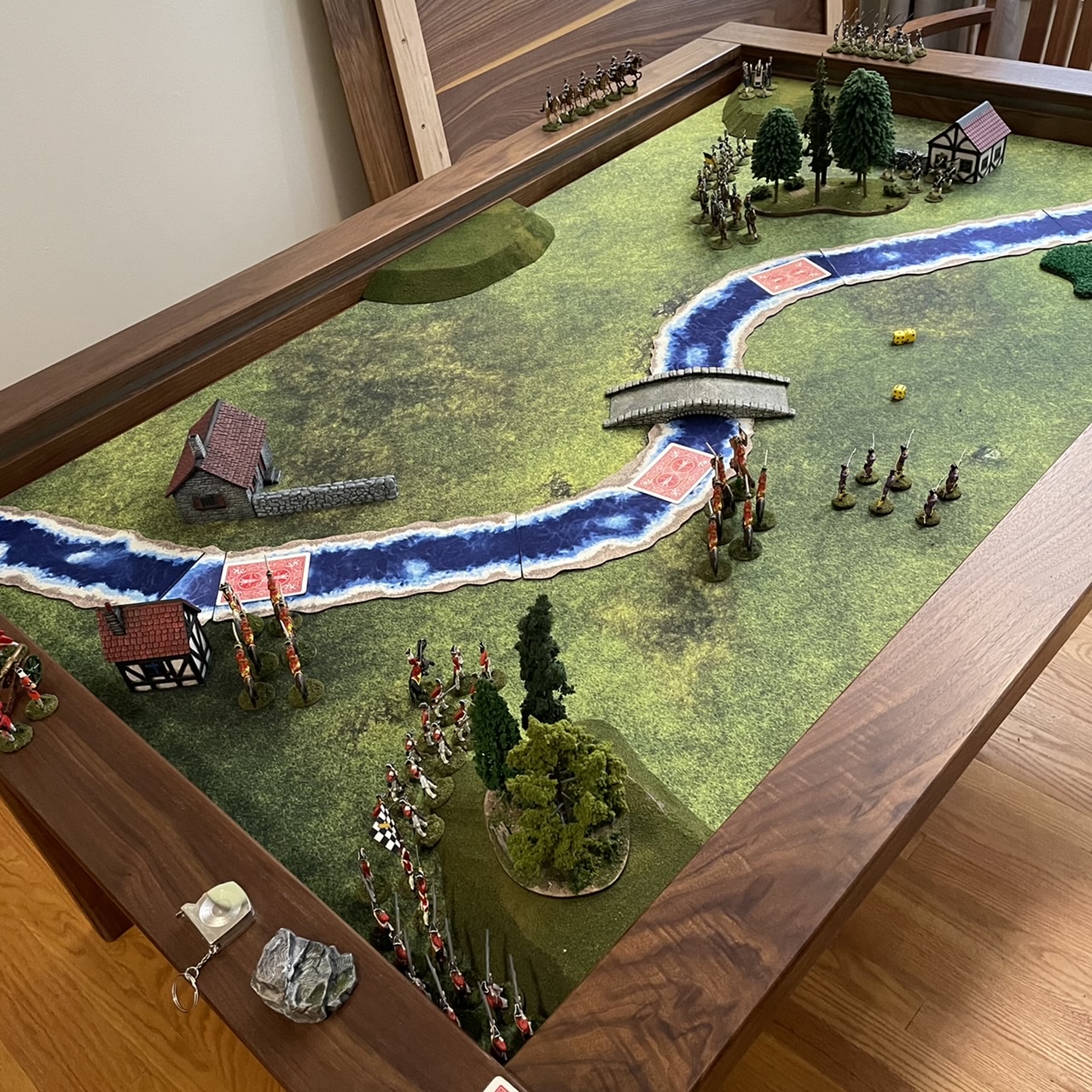
Unfortunately for the Coalition, the League was alert to the danger presented by the bridge, and dispatched a force to secure it, under the command of Brigadier Regelnmann. Curiously, its composition was much the same as the Coalition’s force: two battalions of line infantry, two squadrons of dragoons, and a battery of artilley, all native Schluesselbrett troops, plus a small detachmanet of Saxe-Kirchdorf jaegers.
Advancing toward Steinbruecke from the north (right side of illustration), Regelmann set his dragoons ahead to determine if the river was fordable anywhere.

Finding no usable ford upstream of the bridge, the League’s forces continued downstream. As the Saxe-Kirchdorf jaegers neared a third possible crossing point, they saw a squadron of Schoeffen-Buschhagen dragoons on the south bank. Preparing to open fire on them, they were surprised when the dragoons splashed across the river and charged them! The jaegers were unprepared for the onslaught, and hastily retreated.

As both sides converged on the crossing point, a squadron of Schluesselbrett dragoons hastily attacked the now-disorganized S-Bs, who in turn retired back across the river. By then the lead elements of S-B infantry were able to drive the League dragoons off with musketry. The S-B artillery battery was soon deployed and was able to bring the northern (lower in illustration) side of the crossing under effective fire.
For some reason, General Regelmann’s League infantry was slow to deploy, and the Coalition infantry was able tgo cross the river. Meanwhile , the League cavalry discovered, upon questioing a local farmer, that the river could be forded with some difficulty upstream of the village (left of illustration), and a portion of the League force was dispatched to make the attempt.

The sun was sinking as a ferocious firefight broke out between the two infantry lines. Both commanders were in the thick of the action, rallying their men. On the south bank, a cavalry fight broke out, as a single squadron of Schluesselbrett dragoons, eventually aided by the Saxe-Kirchdorf jaegers and the long range fire of their artillery, faced down the remnants of two squadrons of their Coalition counterparts.

As the day ended, the situation remained in doubt. The Coalition was in possession of both sides of the crossing, but the damaged bridge was contested, and their cavalry had been very roughly handled by the League. Both sides sent messengers seeking reinforcements in the expectation that the fight would be renewed in the morning…
Player’s Notes
With the HAWKs back to holding face to face meetings, I would like to dust off the Not Quite Seven Years War project, and give the other club members an opportunity to see their forces on the table. It’s been a few years since some of them have been out. While I’m not done with Charge!, there is no doubt that it would be more practical to use some other rules, preferably with smaller units, for a club night game. We have been playing A Gentleman’s War for the last couple of years, which I like well enough, but I haven’t been able to make it work for multiple player games to my satisfaction. Therefore, my expectation is that I will use Ross Macfarlane’s home rules With MacDuff to the Frontier for this.
With that in mind, I invited Ross to join me in a remote game to get the rules fixed in my mind.

Since the last time I hosted an NQSYW game remotely, I’ve upgraded my remote player set-up. I can now put the iPad in a clamp on my heavy-duty photographic tripod.
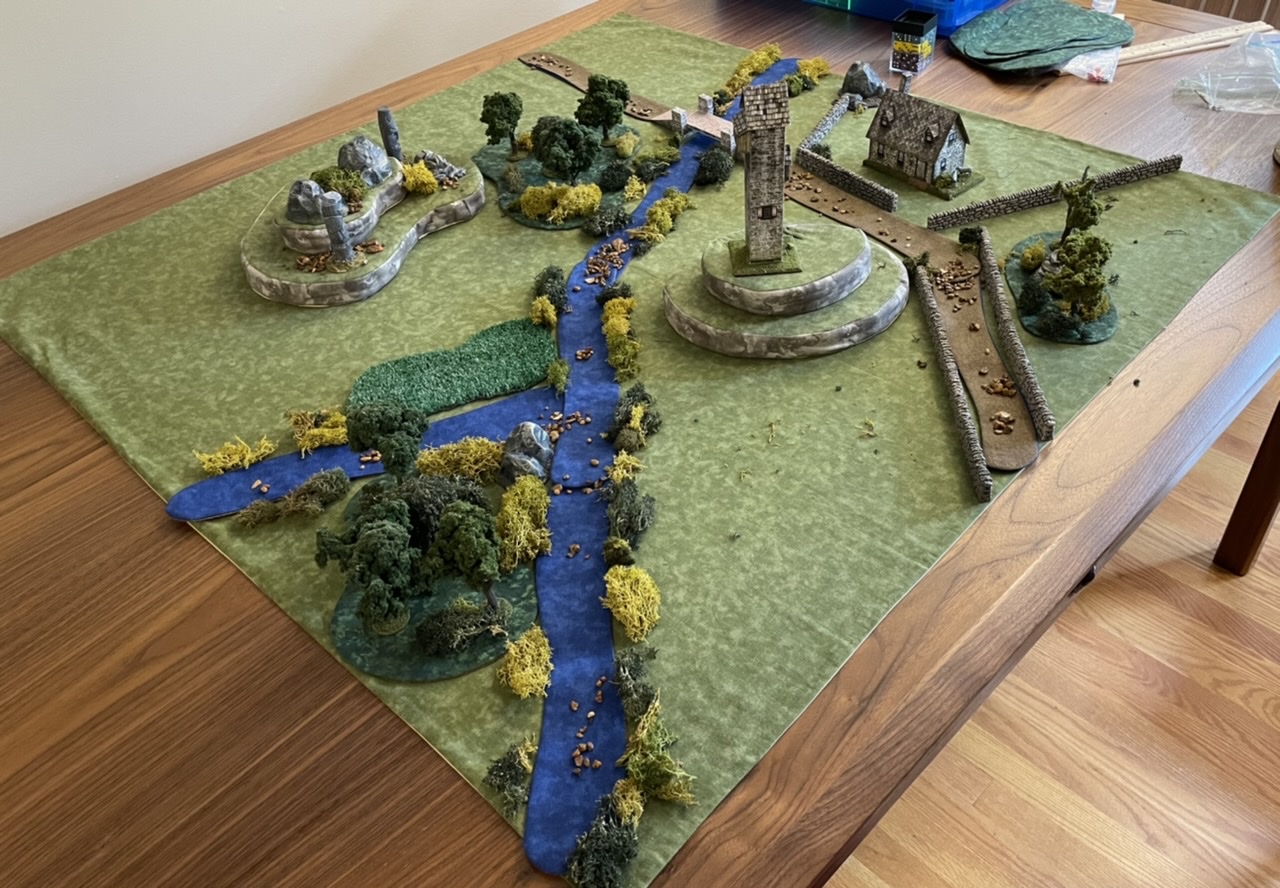
Yesterday was a bit of a rough day around the house, so my preparations were not as thorough as I would have wished. I looked through the Grant green and red scenario books for something suitable. My desire to try something new was conflicting with my need to get set up, and I decided on Scenario 13, Finding the Ford, from Scenarios for All Ages (the Red Book). I kept the scenery to a somewhat expedient level, without a lot of extra detail, and using the subscale 3D printed buildings I’ve painted up during the pandemic, since I was both short on set up time, and in need of fast clean up so that supper could be eaten afterwards. There are some challenges with using your gaming table as your dinner table.
Nevertheless, despite the challenges, the game eventually got played. We used Discord for a change, since Google Hangouts, the conference system of choice these many years, is being obsoleted by Google. It was good to see the figures out, and I have some ideas about optimizing large figure games on a smaller table which I need to write down while I still remember them…

The humans were watchful, though, in this uneasy border region, and from the top an an old tower visible across the river, a horn call sounded. Not abandoned after all … Uccsai ordered the troop to forget about the bridge; the river looked shallow enough for safe crossing if they were quick about it. His warriors were not. Exhausted from the days’ march, they were slow in reaching the ford, and quickly fell in a line, as a few eager yopungsters, anxious to prove themselves, pressed ahead, while the rest lagged.


Norman wrote up a report on the “bracket campaign” for the DBA forums after our visit over the Memorial Day weekend, now three weeks ago. My intention to blog about this sooner was completely overwhelmed by quotidian reality.
It was nice to see all of his painstaking pandemic painting placed in play.


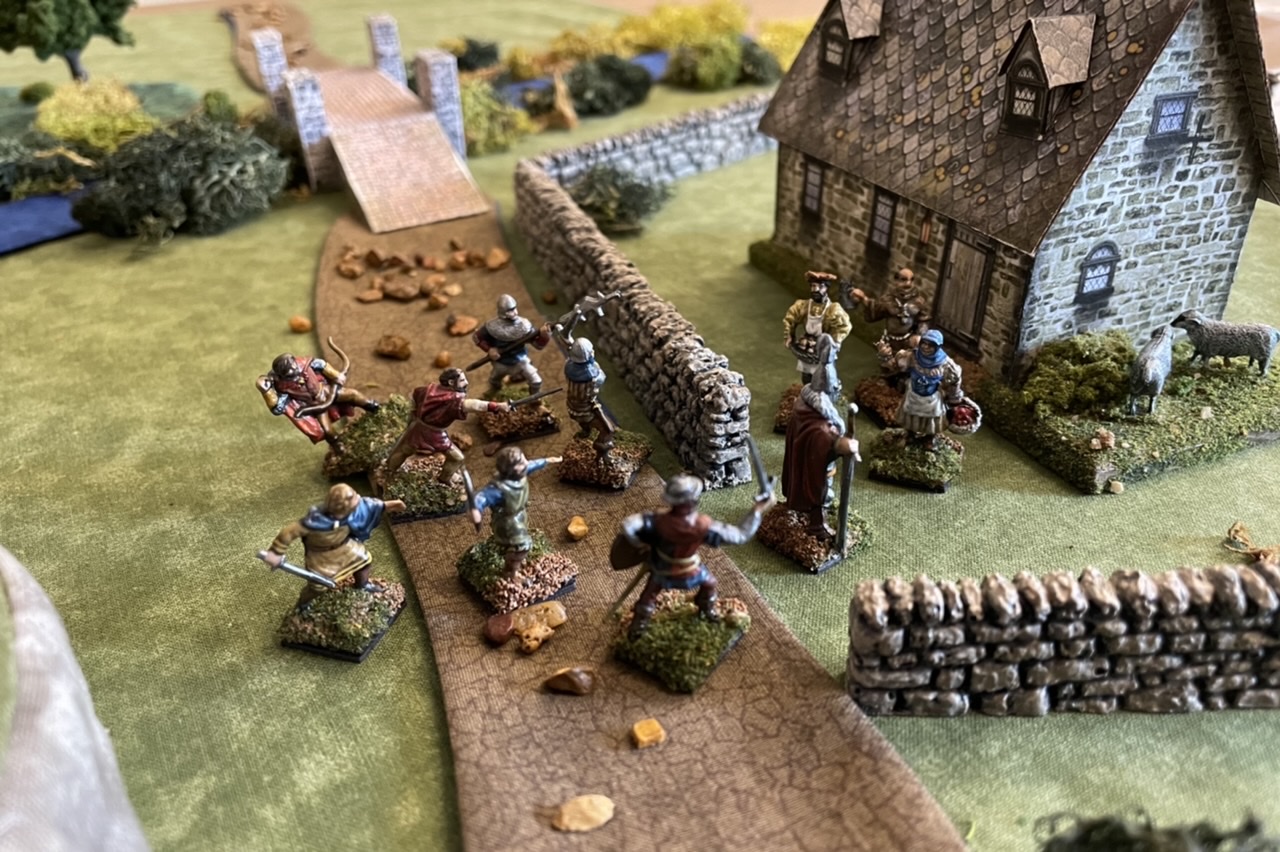
With last weekend’s painting, I finally had enough newly completed Prince August figures to run a little solo skirmish with A Song of Blades and Heroes (SBH). SBH recommends a typical game of 300 to 500 points. I have noticed previously that the point system doesn’t seem to be as finely balanced as the carefully calibrated two-significant-figure point values would suggest, but, there’s a lot of randomness in the game, and it was going to be a solo game anyway.
One warband consisted of orcs and friends (an orc leader, three orc warriors, a troll, two goblin wolf riders, and a spare goblin warrior). The other was all human (a leader, two warriors, two archers, an apprentice magician, and a cavalryman), and I managed to finesse them so that each was exactly 300 points.


I set up a battlefield on my dining room table, using a “Kill Team-sized” neoprene matte (22x30”). The road and river are also neoprene pieces. The road predates the pandemic, and the river was purchased just as everything was locking down. The three-dimensional elements of the terrain are all pieces that have been completed in the last year, as were the troops. So this game finally closes out this little digression, by having been created (almost; roads excepted) since the lockdowns started.
Upon looking over the table, a scenario suggested itself. The humans simply need to cross the table, unlock the tower, and get inside. Had this been properly planned as a narrative battle, I would have given everything names, but, after months of delay, I got a bit impatient and just played...


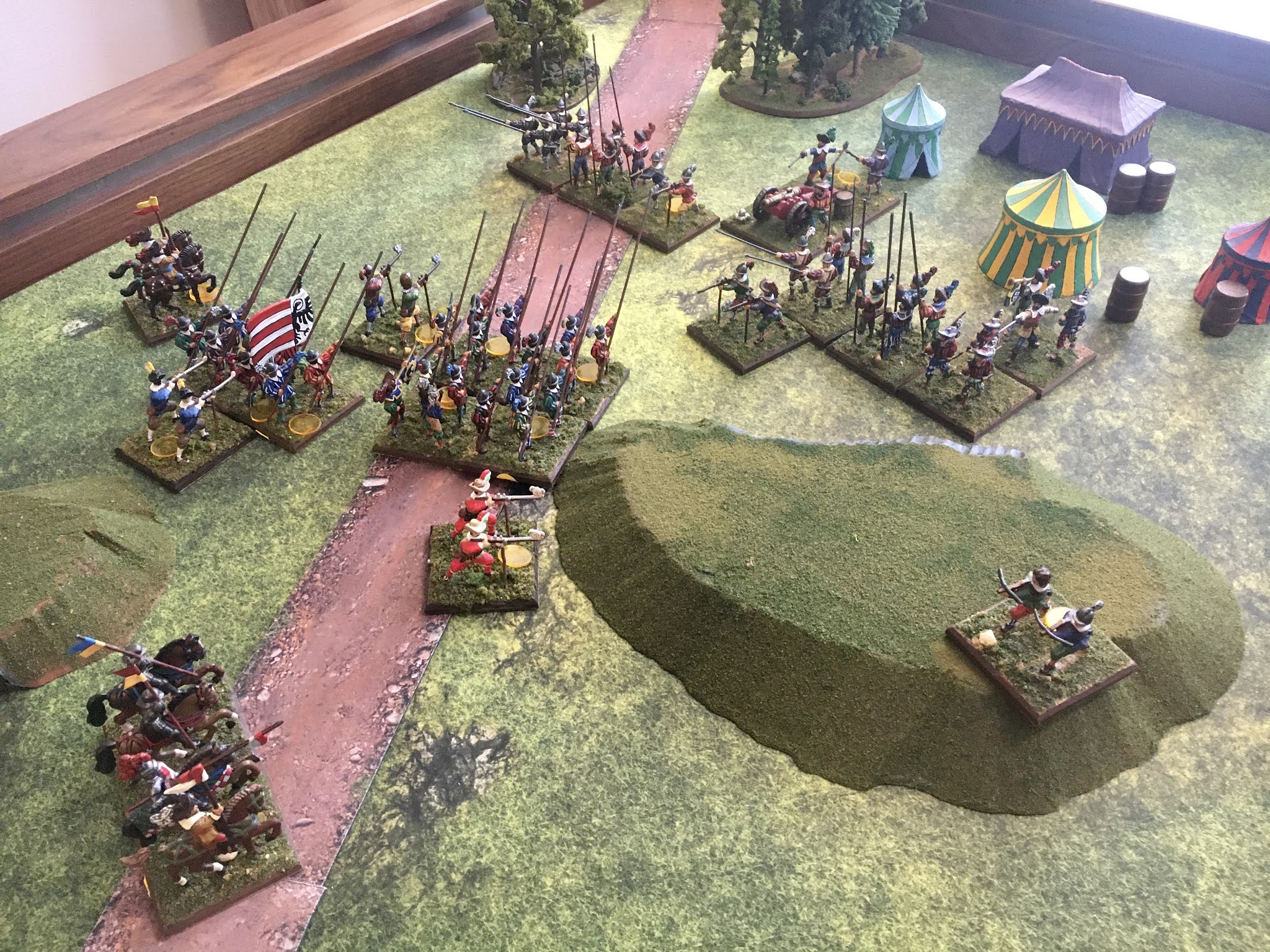
The camp’s defenses (to the right) have formed up to meet the Usurper’s tired troops

Screen capture from the central game server...
Theat wasn’t a bad weekend for games; I also finally set up and played a Dragon Rampant scenario generated by my solo campaign, which had been awaiting resolution for several months. The nice thing about a solo campaign is that the opponent doesn’t get bored while waiting for the next move to be resolved.
I used some orcs borrowed from Norman and some of my general purpose fantasy/medieval 1/72 scale figures to resolve an encounter out on the eastern borders of the human kingdom of Darmis. I ran the “Into the Valley of Certain Death” scenario from the rule book, in which both sides have stumbled into some inhospitable territory. In this case, I considered it to be an area of traps left by the elves, who are happy to wear down either or both parties.

The board is supposed to have 50% of the area covered in scenery, and any unit entering a terrain feature for any reason takes hits. The units were, for the most part, able to maintain control and stay out of danger, so I was glad to be playing solo. I don’t think that it would have been too much fun as a regular two (or more) player game.


For my most recent micro-project, I stayed with the 1/72 scale fantasy theme with some baggage and a camp follower/NPC. While cleaning up recently, I found a group of figures I had washed prior to priming some months ago. Included in the group was a small flock of sheep, which I had started when I did a campaign battle last October, for which I had needed three baggage train items for an escort mission. I had two, and filled in the third with a mounted Maid Marian from the Airfix Robin Hood set. The sheep are from the Pegasus farm animals set. I decided after I had started them that I wanted a shepherd of some sort, so another Robin Hood set figure was drafted for the purpose. For figures the Plastic Soldier Review lists as having been released in 1964, they hold up very well considered alongside some of the modern manufacturers. The pregnant woman came from the Linear-B/Strelets Roman transport set. The review notes that her costume isn’t particularly accurate for Roman times, but she fits right in to the generic fantasy themed collection.


I’ve got several things on the painting desk this weekend, so I shall hope to finish something tomorrow. I have been using the desk as my work at home space, and I will need to be cleared off again by 7:30AM on Monday.