Showing posts with label NQSYW. Show all posts

Wednesday, September 24, 2025

All Based and Ready to Go (NQSYW and 54mm Fantasy)

 It has taken a few days since my return from visiting my father to finish up what I had painted, and I also had three more of the NQSYW figures which needed basing.


That brings a Charge! company up to full strength, so I will need to find a way to get it on the table this Saturday.

I also finished the one witch.


Next up on the painting table will be a few more 54mm fantasy figures.  I’m trying not to look too far ahead, so I won’t predict what might be after that.


Thursday, September 18, 2025

Some NQSYW (and other) Painting


Please pardon the cluttered table picture!  I have been visiting my father on a regular basis this past year, and I usually try to bring along some sort of hobby project I can work on in the down time.  This trip I brought along the travel paint set and some NQSYW figures for the red-coated army of the Archbishopric of Schlüsselbrett.  When we picked up the redcoats in the Annexation in 2011 there were a few figures with yellow facings that didn’t amount to a complete Charge! company, so I eventually cast up the rest of the needed figures and have worked on them very intermittantly for the last several years.  (More libations for the Muse Clio would be in order, I suppose … ) I was down to the last four I had in progress, so that’s what I brought, figuring that finishing them wasn’t too ambitious.


So, while my father was off to his volunteer gig at the Henry Ford Museum I buckled down and knocked these out. I should have time to get all the basing done to allow the company to appear on the table at Barrage next week.

After playing A Fistful of Lead last week I was also inspired to bring along a few 54mm fantasy figures.  (I have the magic/fantasy expansion for those rules.) I finished off one sorceress, from the old Toys R Us Mythical Warriors play set. (Less the basing, as I didn’t bring the basing or final varnish materials with me…)


During my last burst of inspiration for 54mm fantasy I picked up a bunch of Marx recasts (knights, Vikings, and Robin Hood), so I have plenty of possible figures to paint.  With a bit of help from the Muses, perhaps I can get an initial game on the table some time this winter.


Wednesday, September 10, 2025

Foundry Day

 I have been preoccupied this summer and have not taken advantage of the warm weather to do any casting since May. My wife, being an industrial hygienist, has advised me to keep all of the casting outdoors, so hot sunny days are the best for this.  (In fact, as long as you stay well hydrated, ridiculously hot days are the best of the best, so I don’t mind the occasional heat wave.)


Earlier this summer I bought a new clean melting pot so that I could keep any potential lead contamination out of things to be cast for my grandchild, and it seemed like a good day to give it a test.  It’s an actual Prince August device that requires you to dip the metal out of an open-topped pot with a ladle, so I wasn’t sure how well that would work.  Future grandchild toys are not urgent, however, and my younger son has been waiting for me to cast some Prince August marching grenadiers for him, to complete a unit.  Working alone, casting three or four molds makes for a good work flow, so I pulled out the grenadiers he needed, a pair of grenadiers firing, a drummer and standard bearer, and an officer and musketeer advancing.  I did three at a time, swapping the officer and advancing guy out for the drummer/standard bearer after producing a couple of good copies of each. Getting 50 successful figures this way took me about two hours, including the set-up time.  I’d have done more, since the set-up time had already been invested, but I had to go pick my car up from its maintenance appointment.


We haven’t been adding much to the Not Quite Seven Years War (NQSYW) collection in recent years, but I guess the big game we did last year at Barrage (see his commentary at 10:05) inspired him, and who am I to argue with inspiration? 


I also handed off a cavalry squadron to him recently, so I look forward to having a game with some new figures on the table, perhaps by the next spring.


For that matter, I have some NQSYW figures on my painting desk now.  These figures are to complete one of the units acquired in the Annexation back in 2011. (2011 ?!?!) I suppose that it’s more than time that they be completed…

There will be a modest NQSYW game (using Charge! as is customary) coming up at Barrge 2025 in a few weeks.  I hope to have a Barrage AAR, and I also hope that I will have these figures all based and varnished so that the unit can appear in the game.

Monday, June 24, 2024

The Perfect is the Enemy of the Good, or Two Recent NQSYW Battles

 This year continues to be a slow year for getting much done with the wargaming hobby.  I have not been painting much, and, at almost halfway through the year, I have a mere 11 games in the logbook.  That said, the two most recent games were both Not Quite Seven Years War Charge! games.  I have been delaying on getting them written up as proper fictionalized battle reports, and have decided this morning that something written would be better than the perfect report never set down.

The Bridge at Gehoelzkirche

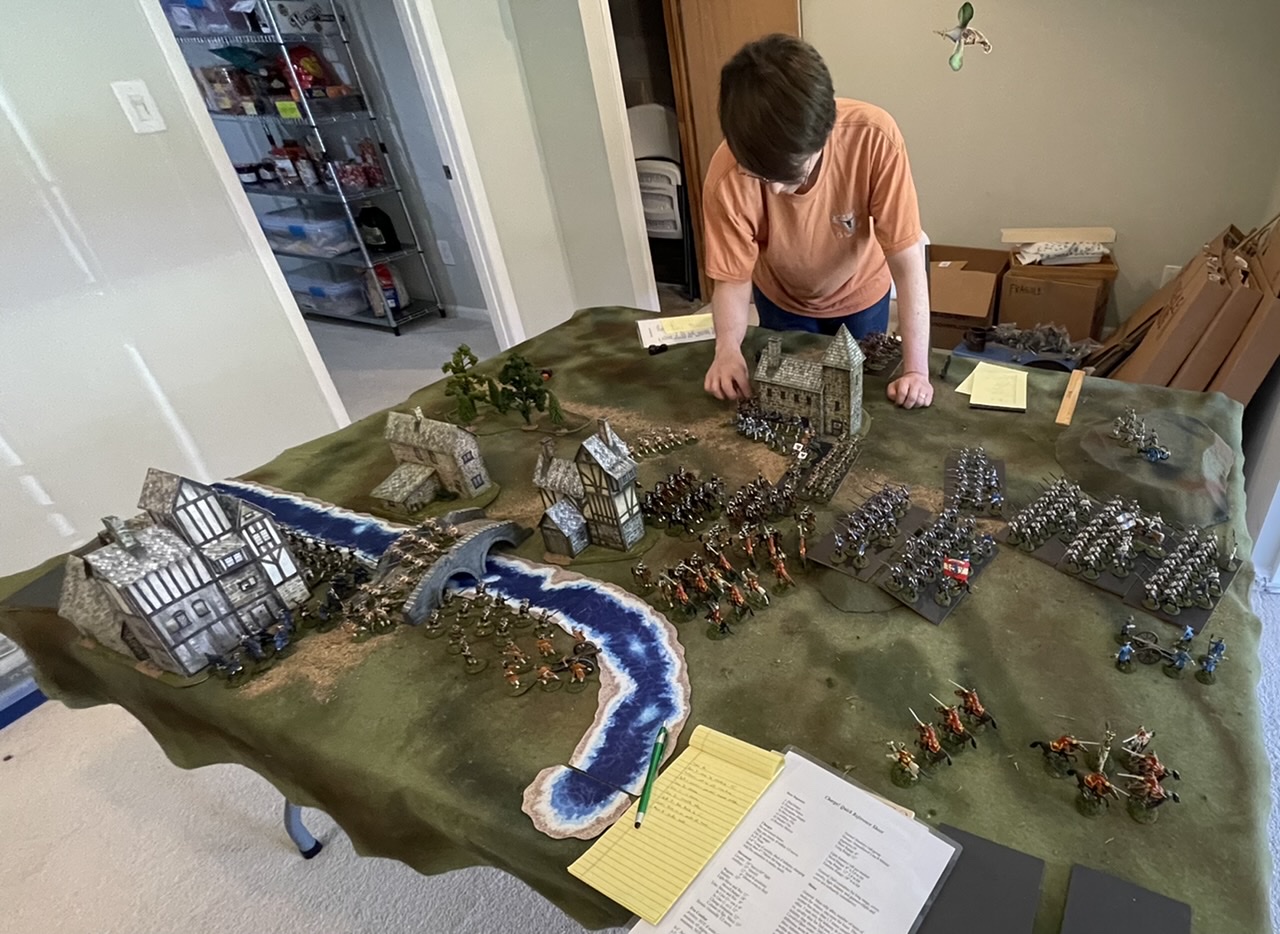
The HAWKs hosted a game day on the 8th of June, and I volunteered to run a Not Quite Seven Years War game since I hadn’t seen the troops on the table in w while. Additionally, Ross Macfarlane  had sent me a contingent of troops from Rosmark during one of his bouts of downsizing, over a year ago, and they hadn’t yet been out.  I had a video chat with Ross to make sure I knew who was who, and arranged with Chris Palmer to borrow the North Polenburgers. I decided that the scenario would be “The Vital Bridgehead”  from C.S. Grant and Stuart Asquith’s Scenarios for All Ages.   This is a slight adaptation of “Sittangbad”, the example scenario from Charge!. I was a little startled to find that I had enough troops on hand to deploy the scenario using full regiments (~60 foot or 30 horse).  I set it up on a 6x12 table, and didn’t quite work out the movement rates vis-a-vis table size correctly.


Here in the foreground can be seen the small town of Gehoelzkirche.  As the scenario fell out, it was defended by a mixed force of the Northern Alliance (Rosmark and North Polenburg) who were falling back in the face of a superior force after a failed raid into Schoeffen-Buschhagen.  As they reach the town, they discover it is choekd with vital supplies which need to be evacuated across the bridge before the brdige can be destroyed.  In the farther distance, another small village is available to serve as a defensive strongpoint, and was garrisoned by a battalion of Rosish Pandours (light infantry for this game).  Two regiments of infantry and some supporting elements are in the open area between the two towns, and one regiment of infantry protected Gehoelkirche and the bridge.


The attackers, the Pragmatic Coalition, with four infantry regiments, three cavalry regiments, and various supporting troops needed to capture the bridge and trap the Alliance force on the wrong (west) side of the river if possible.  


Now, as referee I made a mistake in not allowing the attackers enough time to potentially get infantry across the table to interfere with the evacuation of the town and subsequent withdrawal of the troops.  It’s possible that the cavalry, if boldly handled and indifferent to the casualties, could have forced their way through the defenders between the towns, but this wasn’t put to the test.  The attackers spent a great deal of time attempting to force the Pandours out of the smaller town before finally compelling the Pandours to surrender.  As a delaying tactic, it worked brilliantly.  


With time to evacuate the supplies, the Alliance forces began to cross the bridge (led here by two squadrons of Rosish carabiniers) back into the safety of West Rosmark.  Overall, I wasn’t pleased with my lapse in scenario adaptation, but, other than that it was a fun and visually spectacular game.  I later calculated that we had about 630 home cast 40mm semi-flat figures on the table, which did contribute to some traffic james along the way. Perhaps I should paint up some Schoeffen-Buschhage provosts to direct traffic…

Encounter at Gaithersburg

Just a week later, on the 16th of June, I took the troops on the road to visit my elder son’s house.  For Father’s Day, we set up another Charge! game, this time using scenario #2, “Threat to the Flank” from Scenarios for All Ages.  Knowing that we would be using a 5x6 foot table, and having the recent time and traffic troubles in my mind, I decided that we would scale this down, and deploy Charge! companies and squadrons for the units, rather than regiments.

After the failure to trap the raiders at Gehoelzkirche, the Pragmatic Coalition was attempting to gain some advantage by continuing to pursue the retreating Alliance forces.  The Alliance chose to make a stand at Gaithersburg.


I took the part of the Northern Alliance, defending some high ground behind a shallow river.  The Pragmatic Coalition forces (mostly provided by Norman’s Wachovians and William’s Wiegenburgers) had sent a flanking force to their right to use a bridge further up the river to outflank the defenders.

They had a quick conference and decided to reject the scenario’s pre-set outflanking plan in favor of a frontal attack across the river and up the hill.  As it happended, the Wachovian regiment in the lead was shot up pretty throughly by the defenders, but the Wiegenburgers behind them were mostly screened, and successfully took the hill on the second assault.


What then amounted to a diversionary cavalry action at the bridge had no significant effect on the outcome of the battle.  


Overall, it was a fun (albeit short) game.  We probably spent more time deploying and packing away all of the indivisually based figures than we spent actually playing.  However, we had reservations for an early dinner, so everyone accepted the schedule constraints. 

The Future

At this point I had already submitted a notice to the organizers of Barrage (27-28 September) that I would like to put on a big Charge game, so we’ll be looking to fill a 6x20 foot table.  Various HAWKs are dusting off or expanding contingents that haven’t seen battle in years.  Perhaps we’ll see you there …


Wednesday, September 13, 2023

Not Quite Seven Years War with One Hour Wargames

 I am not making much progress with my resolution to blog more this year…perhaps I can alter my habits by January, a more traditional time for resolutions.

At any rate, I have a list of rules and periods I have been wanting to try, and I had some time this past Sunday to check another one off the list.  At some point during the pandemic, I bought some magnetic movement stands from Litko, sized for units in One Hour Wargames. My intention was to use them to temporarily mount stands or figures from other projects; I should be able to do some sort of ancients, Dark Ages, Pike and Shot, and Horse and Musket.  First up (finally!) was Horse and Musket.  I randomly selected a scenario from the book, which turned out to be Scenario 1, Pitched Battle, based on Ceresole in 1544.  I used figures from my NQSYW collection to field a Red (League) army of 3 infantry, 1 skirmisher, and 2 cavalry aganst a Blue (Coalition) army of 3 infantry, 2 artillery and 1 cavalry.


While not the best idea, I looked at that and decided that the League either had to withdraw or attack, since they would otherwise be worn down by artillery fire without being able to respond.  The 3x3 table doesn’t allow a lot of maneuver, and the horse and musket rules give infantry a 12” range, so it was a die rolling contest for the most part.  The game ended on turn 11 with a charge by the Coalition dragoons scattering the last League infantry.


I followed the suggestions in the short chapter on campaigns, and did a follow-on game by allowing the winning side to choose which position they would take in randomly determined Scenario 12, where an army defending a town is about to be outflanked by an attacking force which discovers a usable ford.

I elected to have the Coalition play blue, the attacker, and thereby relegated the League to the role of Red, the defenders.  The dice gave the same force composition for Blue (obviously they just continued the advance after the first battle), and Red now had 4 infantry, one artillery, and one cavalry.


The attacking army is prohibited from shooting on turn 1, and must set up within range of the defenders, so things got off to a bad start for the Coalition; three League units concentrated fire on one Coaltion infantry unit and broke it immediately.  The Coalition cavalry rode for the objective hill and were met by the League cavalry. By the rules (as I understood them) this resulted in an indecisive melee on the hill for several turns.  The Coalition artillery was generally ineffective, and the final situation saw all units broken except for the League cavalry and one Coalition artillery surviving on Turn 15.  Without the hill in their possession, victory went to the League.

This was only my second experience actually laying with this rules, and the previous time we played the 19th century version.  They seem reasonable for a first introduction, but I do have an urge to complicate them a bit … perhaps next time.  It wasn’t a bad way to spend a rainy Sunday afternoon, though, and, as is usually the case, I was glad to get some figures on the table.


Monday, October 10, 2022

Barrage XXV, 23-24 September 2022

 It is hard to believe that the HAWKs reached Barrage 25 this year; it still seems like only yesterday when someone suggested at a club meeting that a game day would be a good idea.  We went to two days a couple of years ago, and this year we had over 200 attendees including club members.

Unfortunately for me, I had to miss the Friday events, as I was returning from a work trip to Utah over which I did not have schedule control, and didn’t walk in the door at home until 9:30PM on Friday.  I was signed up to run a Not Quite Seven Years War game on Saturday morning.  While I had spent the weekend before the trip organizing my flea market offerings, and ensuring that I knew where all of the Bronze Age gear that my son Norman was going to need was stowed, I did not have the NQSYW scenario materials pulled out.

Therefore, I got an early start on Saturday morning, pulled all the stuff up from the basement, and got it loaded.  It still wasn’t early enough to avoid a bridge closure due to a running event, but at least I knew that it was likely to be happening this year.  Carrying around a stack of boxes loaded with Charge! regiments in 40mm does leave me wondering these days whether I should be recreating the NQSYW in something a little more portable, such as 1/72 scale plastics …


Chris Palmer brought the North Polenburger army, so the scenario involved an attempt by the Northern Alliance, here represented primarily by North Polenburg, to hold a bridge long enough to allow an evacuation after nightfall.  The Pragmatic Coalition was represented by Schoeffen-Buschhagen, Wachovia, and the Imperial Free City of Wiegenburg, as usual. 


The North Polenburg 32nd Dragoons made an impressive display on their gray horses, as usual.


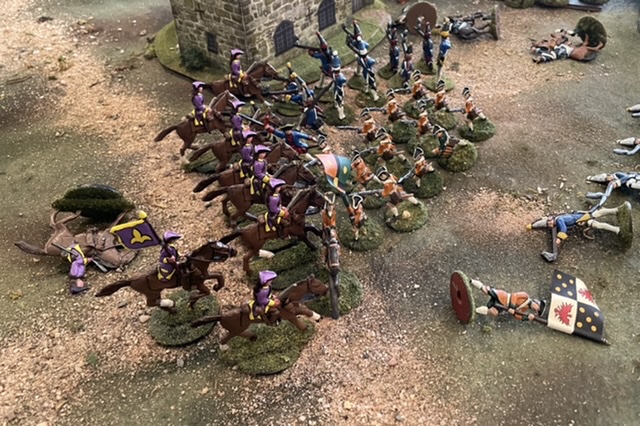
They fought well, although there was one moment when the lone Wachovian Hussar standard bearer fought off a pair of Dragoons and preserved the flag; a commendation is no doubt in order.


As the battle progressed, the Coalition left flank gradually pushed in the Alliance’s right, in a series of cavalry charges and countercharges so typical of the rules.  The Wiegenburg Regiment (center right) in their white coats (and leading their mascot into the action) suffered heavy casualties in a direct assault on the Alliance line defending the bridge and were eventually forced to withdraw.  A follow-on attack by the Schoeffen-Buschagen Adelmann Regiment, though, was more than the defenders could withstand, and the game ended with the Alliance forces being compelled to withdraw in disorder, seeking an alternative crossing location.


It was, as always, nice to have the NQSYW back on the table.  As I’ll discuss below, there are several reasons why that project is on the top of my mind right now.

Norman has been working steadily on expanding the Bronze Age 1/72 project since last year’s Barrage, and he staged an afternoon game of Egyptians versus a Sea Peoples alliance using his home rules (NURD: Norman’s Universal Rules Design) which looked like it went well.  He ended up coming up prepared to rebase a few of my Egyptian chariots on the spot, to ensure that the Egyptians had the numbers needed.


My flea marketeering went well.  I arrived with four boxes of stuff and returned home with two, plus  $370 in pocket, so I was pleased.  It’s no fault of Reaper Miniatures, but I sold off a lot of Bones 5 figures.  I have concluded that I am more interested in recreating (or perhaps just creating) the vision of fantasy miniatures I had in my youth, so I expect to be putting my effort into expanding my vintage 25mm collection instead of trying to keep up with the latest styles.  


Afterword:

I mentioned that there were a couple of reasons why the NQSYW was on my mind.  Back in August, right after Gen Con, my pre-ordered copy of Henry Hyde’s Wargaming Campaigns arrived.  As might be expected with Henry Hyde, horse and musket campaigning is front and center, so perhaps this will finally kick me over the edge into doing another NQSYW map-based campign.


Additionally, William, my second son and the originator of the Pragmatic Coalition’s Imperial Free City of Wiegenburg, has landed a job in the Washington DC area, and will be returning to this general area next week.  His appointment is for at least a year, so his brother and I have been considering some possible agendas for game days, especially since Norman’s basement, as seen  back in June is suitable for miniatures.


Friday, June 24, 2022

Information on Schneider Molds


I really should know better than this, but I realized the other day that I might have more luck in finding some information on Schneider molds if I Googled in German.  (“Schneider Giessformen” …) In the process I discovered that this book was available through Amazon.  Since it is a print-on-demand, it came promptly, and even has a text (in smaller print) in English following the German.  I’m still absorbing it, but there is more information (and more molds…) out there than I had imagined.


Prompted by last week’s Not Quite Seven Years War game, I decided to return to the painting table, and dug out a partially completed unit I started working on sometime last year.  All the way back in 2011 (??!?) we acquired someone else’s partial imagi-nations project.  Most of the units have been rounded out, but there are still some partial units that have never been regularized and brough to the tabletop. These red coated troops will be a second regiment of infantry (or part of one, at least…) of the Archbishopric of Schluesselbrett when completed.


Monday, June 20, 2022

Battle at Gaithersbruck : A New Blog Post (?!)

 I decided to take a break from keeping up the blog earlier this year, and, if truth be told, I haven’t done much in the last few months that was particularly interesting. However, elder son Norman and I met yesterday to play a few games in his new basement gaming space. By his request, I brought down the Not Quite Seven Years War troops.  As is customary when  playing with just our own collection, though, the battle is set in the somewhat earlier War of the Western League (174x), rather than the actual NQSYW (175x).  All of last year’s NQSYW games were played with smaller units, using A Gentleman’s War or With MacDuff to the Frontier.  For this game, we returned to Charge! despite the limitation of using a 5x6 table. (I will note that Norman’s basement is big enough to deploy a 6x10 table, should we have four folding banquet tables available.)

I chose the scenario from C.S. Grant’s Scenarios for Wargames, as usual.  I have been gradually working through the ones that we have not yet tried, and I settle on scenario 20, “Reserve Demolition”.  This bears some resemblance to the Battle of Sittangbad in Charge!, although the actual Sittangbad scenario is more closely captured by Scenario 8 in Scenarios for All Ages, “The Vital Bridgehead”.  We used the usual proportions for scaling a C.S. Grant scenario to our 40s; about 2 scenario units per Charge! regiment. 

(North at the bottom of the overall picture below)


With the only sappers readily available to us being those of Schoeffen-Buschhagen, that cast the Pragmatic Coalition (S-B and Wachovia) in the role of the defender, attempting to withdraw their forces and demolish the bridge, and the Western League (Hesse-Hattemstadt, Schluesselbrett, and Saxe-Wiolenz) as the attackers.  Given that the last battle we saw in the War of the Western League resulted in a Coalition victory, forcing a river line on the road to Schluesselbrett, it would seem that the League forces managed a counterattack.

In accordance with the scenario book and the rules, we chose a 16 turn day, and diced for the arrival times of two approaching League columns.  As it happened, the first League column, composed entirely of native Schluessebrett troops, did not arrive on the scene until late morning (turn 6), about the same time that the sappers informed the local commander that the demolitions were in readiness. 

The first column was compelled to deploy under a galling fire from the small village at the crossroads, garrisoned by a detachment of converged S-B grenadiers, the Wachovian light infantry posted in the small wooded area west of the crossroads, and a battery of Wachovian artillery.  The cavalry swept around the defensive perimeter set up by the coalition, looking for a weakness.  


A freshly raised detachment of Schluesselbrett light infantry attempted to bring the village under fire, but were soon compelled to withdraw by heavy fire from the grenadiers.

The attacking infantry regiment was also quickly forced to withdraw.  

On the eastern flank of the Coalition perimeter the colonel of the Schluesselbrett dragoon regiment thought that he observed a gap in the Coalition defenses, and order his leading squadron to attack.  


However, the S-B Prince’s Dragoon Guards were ready for them, and sounded the bugles for a charge of their own.  The typical sprawling cavalry melee, of charge and countercharge, with battered squadrons retiring to rally followed.  Fate (or skill) was not with the red-coats that day, as each of their attacks was thrown back in disorder by the Guards.  

As the cavalry battle developed, the Coalition commander (a Wachovian, it might be noted) took advantage of the lull in the western zone of the battlefield to begin withdrawing some of his forces.

Soon (~turn 9) the lagging second column of the League began to arrive by the eastern road, and started to push in the Coalition defenses.  The stolid Wachovian infantry and the S-B grenadiers held firm, but more League troops continued to arrive.  Clearly, this second column represented the main effort.  


It was now time to sound the retreat. 


However, as the remaining Wachovians formed up to cross the bridge, covered by the battered grenadiers, a squadron of League cavalry appeared from around the village and swept down on the infantry.


Seeing little chance that the remaining infantry could extricate themselves from the desperate fight in which they now found themselves, and with the League infantry pushing in steadily from the east, the Wachovian commander ordered the fuses to be lit on the bridge demolition charges.

With a tremendous explosion, the span of the bridge collapsed into the river, leaving the remaining S-B cavalry and grenadiers (as well as some of the Wachovian infantry) on the north (enemy) side of the river. Casualties were heavy on the Coalition side, but history records the action at Gaithersbruck as a Coalition victory, albeit a somewhat Pyrrhic one.  

There were probably stern letters exchanged between the higher commanders of the Coalition force, about the fact that the majority of the troops safely withdrawn were Wachovian, while the Schoeffen-Buschhagen elite troops were sacrificed in the rear guard action, but history records that the Coalition did not splinter over this incident.

It was good to get Charge! back on the table after a hiatus.  We were done by turn 14, having actually started at turn 6, so had nine turns of actual play, not unusual in our experience of the game.

Once we had that cleaned up, we played a couple of shorter games.


Norman pulled out his growing collection of 1/72 scale 19th century imagi-nations figures and we played the small battle scenario from Neil Thomas’s Wargaming Nineteenth Century Europe using the rules from the book.  Then we finished up for the day with a quick Bronze Age DBA game.

Over on the Tradgardland blog there has been discussion of old Schneider molds lately.  My other activity for the weekend was to try casting some of the ones I’ve acquired this past year.  It was a cool windy day, thouigh, so keeping the molds warm was difficult, and things weren’t too successful, unless you need a pine forest:


I hope the gun will work on a better day, as well as this interesting mold I have on an 18th century lady on horseback:


I hope the next post will be sooner than six months from now. 


Sunday, July 25, 2021

Recent battles

 We are currently enjoying what I suspect may turn out to be a respite between pandemic waves here, so while my vaccine remains effective, it has been time to do some face to face gaming.  As I noted a couple of weeks ago, I wanted to get the NQSYW on the table at a HAWKs meeting (back on the 16th), so I figured that “With MacDuff to the Frontier” would be a better fit for table size and time available than Charge!

On the day of the game, I had a look through C.S. Grant’s Scenarios for Wargames, looking for something that would be suitable for the expected limited number of players, and ended up deciding to use Scenario #4, Holding Action (2), which I had never tried before.  


I elected to translate the suggested force ratio to 12 infantry, 6 light infantry, 6 cavalry, or 1 gun with 4 gunners per unit.  Scenery, apart from the river, is relatively sparse, which also made a good choice for an away game.  This was just as well, because, despite my best intentions, I did not allow enough time for traffic and arrived at the meeting in time for a very hasty set up, and then launched right into the rules explanation and game.  As a result, I did not end up taking very many pictures, nor any notes, so reconstructing a detailed battle report is impossible.

Soldiers of the Schoeffen-Buschhagen Adelmann Regiment seize a Hesse-Hattemstadt battery

Western League defenders prepare as Fredonians assault the western bridge

Schoeffen-Buschhagen Hussars discover a usable ford

As the battle played out, the forces of the Pragmatic Coalition (Schoeffen-Buschhagen, Wachovia, and Fredonia were represented on the table) were able to successfully assault the bridges, and the Western League defense was crumbling by the time the Coalition light cavalry discovered a ford and crossed, with the aim of cutting off the retreat of the league forces.  However, the cost of assaulting the bridge was not insignificant, and there was some question as to how closely the Coalition force would have been able to press the pursuit.  All of the recent NQSYW games have been described as part of the campaign to knock the Archbishopric of Schluesselbrett out of the war, and it would appear that the Coalition has finally forced the defenses of the city of Schluesselbrett.

I spent some time last weekend working on NQSYW figures instead of working on my Stargrave crew, so I was compelled to take the field in yesterday’s Stargrave game, the first game that will “count” in our annual campaign, with the same test crew I used last month.

The battlefield; a squabble over a wrecked spaceship

We are still finding our way through the rules, so the game took a little longer than we expected.  It’s rarely my turn to be the lucky one for the day, but my crew brought home three loot markers, which turned out to be quite valuable in terms of the game’s currency.  I did have my captain put out of action at the end of the game, but, happily he merely had a “close call” on the post-game out-of-action survival roll. (Unlike host Chris Palmer’s captain, who was put out of action in the final turn, and died as a result of the survival roll, wiping out all of Chris’s gains in the game…)

As expected, everyone had a look at the rules, and there was a lot of smoke grenade throwing going on.

A brief moment of glory for runner Leftie, who put Don Hogge’s flamethrower man out of action with his knife

Captain Toby, Holly, and robot casecracker G357 looking for loot

Captain Toby reminds Holly that she will have minions to climb trees when she is captain…

Except for Chris, nobody had any catastrophic post-battle results, so most of the “out of actions” were temporary, and things weren’t quite as grim as several players had feared late game.  I hope to get a few more new figures painted up by next month, as well as some additional scenery.

Testing out the new “locked” markers

I think that I noted that one of the differences from earlier games in the series is that loot markers in Stargrave start “locked”, and must be unlocked before they can be carried off.  After last month’s game I went looking for some clear plastic hemispheres which I hoped would look like force fields, to use as “locked” markers. I found these  “bath bomb molds” on Amazon.  There were not very expensive for 30 of them in three different sizes, and seemed to work reasonable well.  With the different sizes, we were able to cover most of the treasure markers we were using.


Saturday, July 10, 2021

Considering the NQSYW …

 Ross Macfarlane recently noted, regarding last week’s “Encounter at Steinbruecke”, that small games with big figures had become his preferred gaming style somewhere along the way.  While I don’t want to lose the ability to occasionally maneuver with 60-man Charge! regiments, it is a fact that home games going forward are either going to be on my 3x5 gaming table, as last week, or on a 4x6 temporary table in the library, as with the “Pass at Gelbehuegul” last summer:


In either case, the games will be more fluid and interesting if the unit sizes are smaller (e.g. the twelve man infantry units and six man cavalry units used in A Gentleman’s War), which gives the opportunity to deploy five or six units across the wide side of the table and still have some open space to either flank.

My Charge! infantry units are generally built from a single pose of Prince August castings (or two poses for the “firing line” units) plus command figures. A full foot regiment includes 48 musketeers, and three each of the various command figures.  So, I am considering, among other things, whether it would make sense to paint a few extra officers so that I could get a nice uniform look among the four derivative units each regiment could form.  On the other hand, I had long considered using a different pose for each of the companies in future Charge! regiments to make it easier to track companies on the table where desirable, and that would limit “pleasantly visual” deployment to three derivative units per regiment rather than four.  It’s been a few years since I painted a new infantry unit (hmmm….2012), perhaps because there are already enough units to more than fill the table.  So I am also considering whether it would be more fun and interesting to paint a few units designed to be twelve figures from the start, since motivation to paint 12 rather than 19 might be easier to find, and it’s likely that is how they are going to be deployed anyway.


To assist in considering this, I dug out the actual partially painted stock yesterday, as well as the box of partially unit-organized castings.  I have notes from last year, after a couple of games of A Gentleman’s War, which show that I was considering adding a couple of additional generals, and it looks like I got as far as priming some extra command figures on at least one occasion. Since primed figures on sticks have a  sad tendency to be set aside for years at a time, I should really get in the habit of writing some notes about my intentions on the bottoms of the sticks, so that I can figure out later what I was thinking … 

The other thing I noticed about the NQSYW, as I was looking through old blog posts for inspiration, is that the first game we ever played with the figures was some time in August 1996, which will be 25 years ago next month.  Here’s a copy of the notebook entry on the game:


We even have a photograph, a happy chance for the film era:


So, somehow, I think that we will mark 25 years of this next month …