Showing posts with label fantastic battles. Show all posts

Monday, March 18, 2024

Fantastic Battles — A Review

 This winter has been a quiet season for my wargaming hobby, but I am hoping that spring inspires me to some fresh activity.

I thought I would get back in the game with a review of Fantastic Battles by Nic Wright. Fantastic Battles (copyright 2020) is a generic fantasy mass battle game.  It is available as a PDF from Wargame Vault for about $11, and as a POD hardcopy from Amazon for about $20.


In considering whether I am going to purchase a new set of rules the basing conventions are the first thing that concerns me. I have vowed to avoid rebasing my miniatures collections at all costs, so I became interested in Fantastic Battles when I learned (from discussions on the Lead Adventure Forum) that it was intended for troops based on squares with a small number of individually based characters to act as commanders.  60mm bases are recommended for 25mm figures, and 40mm for smaller figures. Conveniently, this is how most of my 25mm fantasy collection is based, so it would have seemed like looking a gift horse in the mouth to reject the opportunity to purchase and try these rules.  I should note here that there are also some minor suggested rules changes to account for the use of troops on rectangular bases.

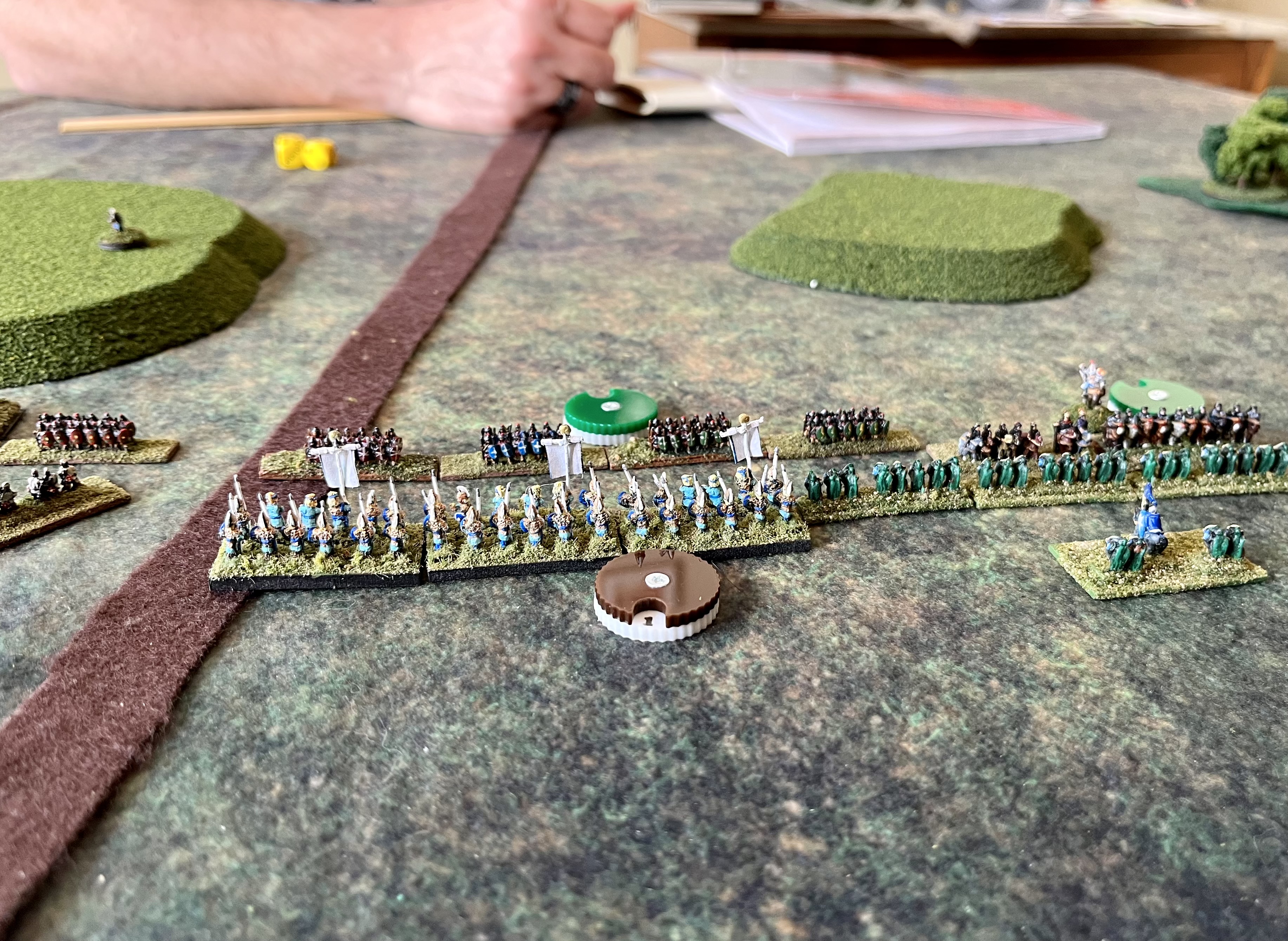
6mm Fantastic Battles with rectangular bases

The actual rules are about 40 pages long, including the lists of spells and unit attributes (“traits”) described below.  There are also four pages devoted to a short campaign system (to be played on a node-and-link map of areas and communications routes), a selection of twelve fantasy armies with points precalculated for suggested units types which cover the usual fantasy trops (humans, halflins, dwarves, elves, goblins, ratmen, lizard men, and undead) plus a set of twelve mostly historical army lists in six matched pairs ranging from Greeks and Trojans to Conquistadors and Aztecs. The book concludes with a two page quick reference sheet.

The rules describe themselves as “setting agnostic”, which is to say that there is no specific background given, and the army construction rules should allow you the flexibility or build whatever sort of fantasy army you like.  Each “company” (a single one of the square bases mentioned previously) is built from a basic type (elite, formed, irregular, fantastic beast, dragon, artillery, or vehicle) customized by adding some of the forty traits to it.  An army can have one overall defining trait (say “Drilled”  for Romans or Gondorians) and each unit can have up to three additional traits. For example, a company of knights might be an elite company with “mounted” and “furious charge”. Each company has five basic statistic: resolution (number of hits it can sustain), move (in base widths or “BWs”), melee (number of dice thrown in combat), shooting (number of dice thrown at short and long range), and defense (target number for an enemy’s attack rolls), plus a base point cost for purchase. The various traits will alter those numbers.  Mounted, for example, increases resolution, move, and melee, as well as increasing the cost.  There are negative traits as well. “Militia”, for example, reduces melee (and cost). Each company’s final statistics and cost are the sum of the base type values plus all of the selected trait values. Costs range from about 25 for an irregular company of goblin warriors to 50 or more for a company of elite knights.

The rules recommend playing with an army cost of about 750 points, and some points will need to be allocated to the command characters.  These come in four basic types, warlord, magician, captain, and rogue. They cost between 25 points for a captain or rogue and 75 points for a combined warlord/magician. So, a 750 point army might consist of three or four characters and perhaps 15 companies (with an average cost of 40).  The game recommends playing a battle this size on a table 30 BW by 20 BW.  For 60mm bases that would work out to be 4x6 feet.  For 40mm bases, a dining room table is probably sufficient.

Before the battle each player organizes his companies into units of one to four identical companies.  These units will be permanent for the duration of the battle. Units of more than one company may adopt one of three formations, line, column, and tortoise, and may change between them as needed during the game. These units pool the resolution points of all the component companies, so that a unit of four companies of irregular goblins at 3 resolution points each would have a total resolution of 12, and will be removed entirely when it takes 12 hits, with no intermediate removals of companies.  So you can organize your army into bulky units with good staying power, or smaller flexible units which are more brittle.

Each turn during the game will consist of three phases: shooting, actions (i.e. maneuvers), and melee. In the shooting phase, all companies with a shooting ability and within range of an enemy may shoot.  Shooting and melee both use the same dice system; a number of dice per shooting company is rolled, and any that equal or exceed the target’s defense value reduce the unit’s resolution.  Markers of some sort, or a roster system, will be needed to track hits during a game. At the end of the shooting phase any units which have taken more hits than their resolution rating are removed, so units always have a chance to shoot back before elimination.

In the “actions” phase, each player has a number of tokens in a cup (or cards in a deck). These are drawn one at a time.  The first draw for each player will activate all of their “impetuous” units, which is defined as those beyond the command radius of a character.  Impetuous units roll a six-sided die, and have a 50% chance of moving as the player wishes; otherwise they will be compelled to retreat, charge, or hold. After the impetuous units are dealt with, each draw will allow the player to activate one character and the units within their command radius. Units may perform various maneuvers; characters have additional possibilities such as spell casting or rallying troops. Enemy units about to be contacted by a unit of the active player may (depending on traits) be able to perform a response, such as evasion or countercharge.


Romans flanking the elves; note cards for initiative and dials to mark hits

When all tokens have been drawn and all actions completed, there is a melee phase.  All units in contact roll melee dice against the defender’s target number as with shooting.  Bonus dice are available for the usual sorts of situations, such as charging and flanking.  Successes reduce the target’s resolution, and, like shooting, destroyed units are removed at the end of the melee phase and therefore still fight back.

The mechanics are fairly simple and straighforward. Players with any background in wargames with miniatures should be able to oick them up quickly. Based on our trial games so far, players should be able to finish a 750 point recommended size game in under two hours, even allowing some time to look up a few rules as you go. The electronic version of the rules also includes an Excel spreadsheet which will calculate unit costs and allow you to print a basic army list.  I would recommend that you add a short description of the effect of any trait in your army with special rules (i.e., that involves more than a simple modification of the five statistics).  That would have saved us most of the lookup time in our trial games.

Despite my having purchased these rules to use with my 25mm collection, we have been playing the trial games so far with 6mm figures from Irregular (mostly) on 40mm WRG bases of varying depths, using the suggest rectangular base modifications.

Overall, the games we have played have been fun. I would recommend these rules if you need a rank-and-flank set of mass fantasy battle rules which provide a good two-player experience in a game lasting less than two hours and playable on a 4x6 table (in 25mm; your dining room table in smaller scales). We have not tried a multi-player game. I don’t expect that I will be using this for a six to eight player convention game to fill a four hour time slot. I note that my opponent thought our first game was enough fun that he immediately ordered a 6mm elf army from Baccus and has been painting it…


Saturday, July 15, 2023

6mm Games and a New 1/72 Challenge

 In the previous post I was painting some 6mm characters and commanders with the intention of using them in a game of Fantastic Battles by Nic Wright. I had mentioned back in March that my sons and I had tried them for a Renaissance game with Leonardo machines, and that the rules were not what I was looking for to run a multi-player convention game.  I wanted to give them another try, and my friend Chris Palmer agreed to be my guinea pig, er, opponent.  As I noted, I am interested in squeezing more gaming out of small spaces at the moment, so I wanted to use the 6mm troops.  I took my box of 6s and a Cigar Box Battles general purpose mat to Chris’s house and we played on his dining room table.  We used armies of orcs (basically impetuous barbarians) and Romans (doughty and drilled).  Allowing for some first time rules look up, we got through a battle in about two hours. As anticipated, this worked better in a more standard fantasy context, and as a two player game looking for that 1-2 hour game.  I look forward to playing it again, and will hold a formal review until we get at least one more game in.  As for an informal review, Chris ordered a starter army of 6mm elves from Baccus Miniatures after the game, so I think that it is safe to say that he was favorably impressed.


View from the Roman right flank as the battle opened


Another view, from behind the Roman center

This past week business took me to Colorado.  Since I knew that the first leg was going to be over three hours in the air, I decided that I would take the tray table game with me and try it out as intended.  Apart from the fact that the Roman legionary infantry did not make it back into the travel box after the fight against the orcs and I was compelled to improvise a bit on the order of battle, I am happy to say that it worked splendidly. The children’s play organizer did a good job of keeping dice and damage tokens confined.  I played two games, with each side (Romans and Sassanid Persians) having one win.  (I should go put the infantry back in the travel box before I forget about it again … ) It was nice to have something to distract myself from the fact that I was packed in a thin-walled metal tube hurtling through the sky six miles above the ground for a little while.


Now, on to the challenge.  Most of the miniatures content on YouTube is Games Workshop related, so I’m always interested when something shows up that isn’t.  There was a video posted on the Tabletop Minions channel last week (Friday, 7 July 2023) in which Uncle Atom presented a route to get into the hobby from scratch with a budget of $100.  The HAWKs presented a similar challenge back in 2003, although our $100 budget then specifically excluded the tools and painting supplies that were necessary to build the projects.  According to the US Bureau of Labor Statistics, the $100 November 2003 budget translates into $165 in June 2023.  Add that to the excluded paint, glue, and tools, and it looks like we were pretty generous in our conditions back in ‘03.

Uncle Atom’s budget includes paint, brushes, and tools.  After considering the matter for a while, I went shopping.  Here’s what I came up with:


I decided to follow Uncle Atom’s advice and start at the Dollar Tree.  For $5.50, I came home with a craft knife, some glue, and a package of cheap brushes that I won’t care about when they get messed up.

For rules, I decided that I would use Nordic Weasel’s Knyghte, Pyke and Sworde, which is available at Wargames Vault for $9.99. KPS is a skirmish game using only standard six sided dice, with forces of up to 20-30 figures per side, but still usable at smaller levels.  So, as troops get painted, the games can begin before all the figures are finished.  Uncle Atom allowed that d6s were probably available for scrounging, so we’ll count them as free although I could have bought a package of them a the Dollar Tree for $1.25.

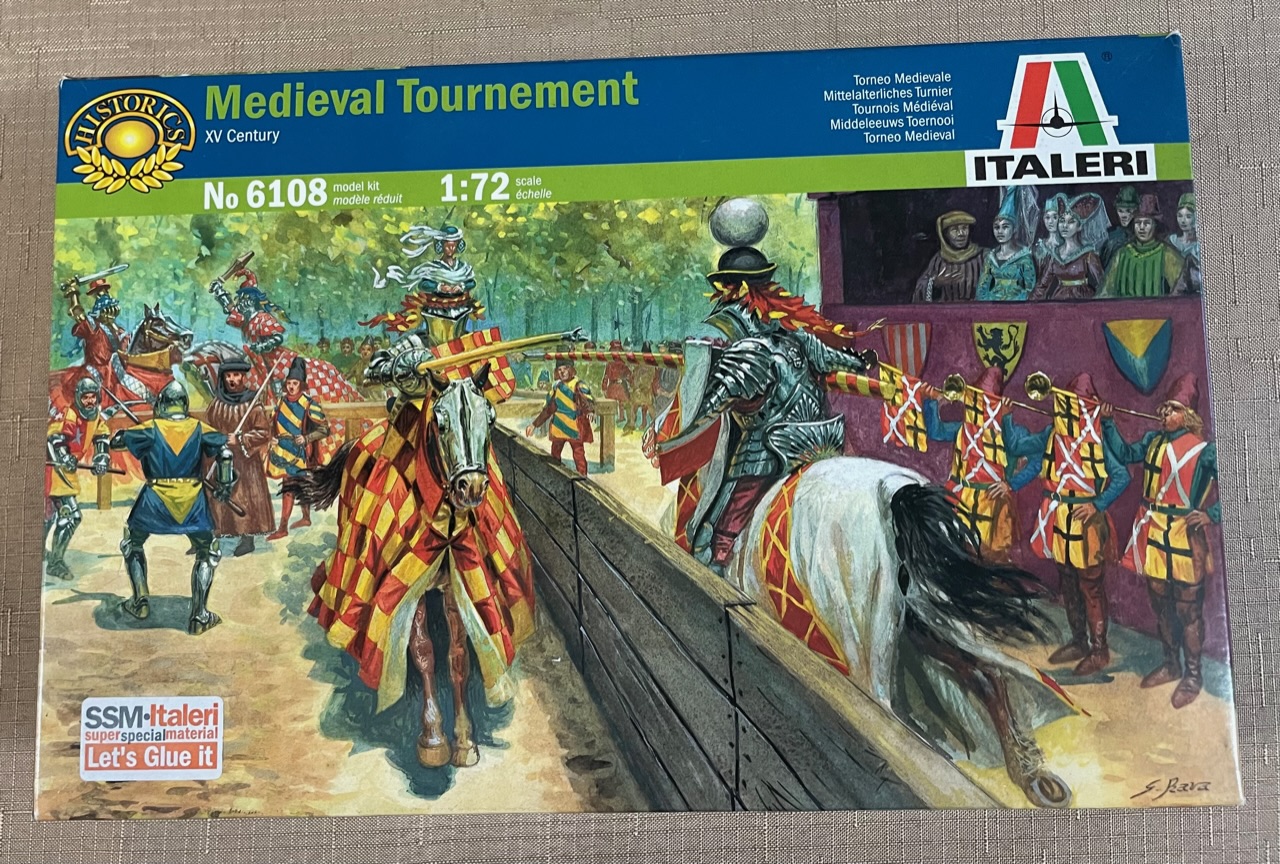
For figures, I decided that this was a good excuse to paint a set of 1/72 scale figures I’d been wanting to do anyway.  For $25 (including shipping!) on eBay, I was able to find a box of the Italeri Medieval Tournament.  This set was originally pointed out to me over on Benno’s Figures Forum when someone posted pictures of the civilians from the set they had painted.


This set includes some tournament knights and specators, plus a viewing stand and the barrier for jousting.


In addition, it comes with one set of the Italeri Hundred Years War English.


It also comes with one set of their opponents, the Hundred Years War French.


The box contains a total of 55 foot figures and 20 horsemen, which should be plenty for a reasonable KPS game.

In order to paint these figures, I would need some primer.  I already have a can, but I priced Krylon Fusion matte black at $6.98.  I’ve used this successfully on 1/72 plastics before.


Uncle Atom used an Army Painter starter set with 10 colors and a brush for $30, but in looking around on Amazon I found a pack of 16 Vallejo “Medieval Colors” for $28.74.   It includes a black and a white for mixing and an assortment of metallic colors, but is a little short on browns, so I’ll have to see what I can do with mixing.  At least most of the horses are caparisoned, so the lack of horse variety will be less apparent.       


To finish the miniatures, a large (60ml) bottle of Vallejo satin varnish cost $7.96.

I ordered a set of three small brushes from some unknown supplier on Amazon for $6.59. I am dubious about their durability and ability to hold a point, but we shall see.  I intend to use the cheaper Dollar Tree brushes as much as possible to save wear and tear on the little brushes.


I priced felt for a ground cloth from Joann Fabrics.  They’ll sell you a yard of 72” width felt for $7.99.  I haven’t gotten over to the local Joann to see what they have in stock yet. That would give me a 3’ by 4’ battlefield with some left over for other possible uses in a potential Phase 2.

So, there we have the plan. The grand total for all of that is $98.75, leaving a surplus of $1.25, enough to buy one thing at the Dollar Tree if necessary.

I am going to count a few things as free which might be reasonably found around a house.  I will need some sand for base texturing.  If I wanted the easiest and cheapest circular bases I could find, I would mount the troops on pennies.  Since I intend to use these troops after I paint them, I will mount them on steel washers which will engage with my magnetic transport boxes, but the pennies would actually work as well for most people.  I will use some white glue.  I will also mount the troops on large craft sticks for painting as I usually do since I have a huge box of them, although strips of corregated cardboard could easily be salvaged and would work as well.

The scenery situation is a bit dire, with nothing but the contents of the box and a ground cloth.  I’ll also count as free some buildings from the  Dave Graffam Models free sample selection. Those are still some way off in the future.  

Given the scenery situation, if I actually get this completed, my Phase 2 challenge will be to enhance the game with a $50 scenery budget.  That will still be under the $165 current value of the 2003 challenge. 

By the way, I might note that my 2003 challenge entry was a 54mm medieval project, using figures that are now out of production.  While I’ve added a few things to the original set, it remains one of my top 6 most played projects since I started keeping records in 1999, so I count it as a solid success.