Showing posts with label remote game. Show all posts

Monday, July 5, 2021

Encounter at Steinbruecke

 Following the defeat at Gelbehuegel (during the War of the Western League), General Nordstrom (commanding the Pragmatic Coalition’s invasion of Schluesselbrett) sought an alternative route to the capital city.  A scouting detachment of light cavalry brought word of a possible route, although it was not without difficulty.  The river Blauwasser presented a considerable obstacle, but there was a damaged bridge at the village of Steinbruecke which might be repaired by the army’s engineers, as long as both banks of the river were held.  Accordingly, a reconaissance in force under the command of Colonel Schultheiss was ordered to seek a possible ford and, if found, cross the Blauwasser to secure both ends of the bridge until engineers were brought up to effect repairs.  Schultheiss’s force was a mixed bag, consisting of a battalion of his own infantry regiment, a battalion from the Adelmann Regiment, a detachment of the King Rupert Jaegers, two squadrons of dragoons from different regiments, and a battery of artillery.

With any luck, this maneuver would go unnoticed by League forces, who were occupied defending the main approaches to city…
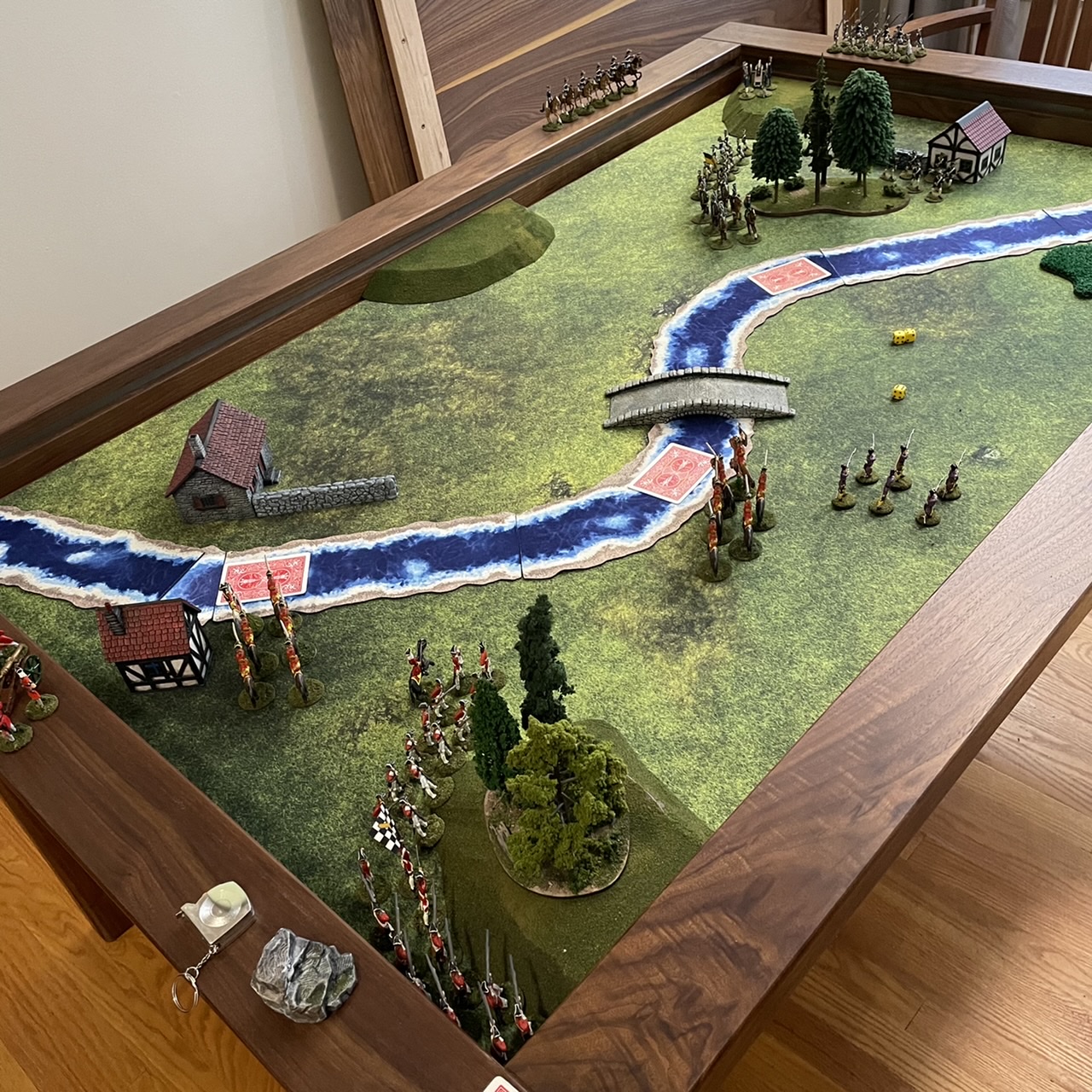
The situation develops: cavalry seeks a ford on both sides

Unfortunately for the Coalition, the League was alert to the danger presented by the bridge, and dispatched a force to secure it, under the command of Brigadier Regelnmann.  Curiously, its composition was much the same as the Coalition’s force: two battalions of line infantry, two squadrons of dragoons, and a battery of artilley, all native Schluesselbrett troops, plus a small detachmanet of Saxe-Kirchdorf jaegers.

Advancing toward Steinbruecke from the north (right side of illustration), Regelmann set his dragoons ahead to determine if the river was fordable anywhere.  


General Regelnmann leads the infantry advance

Finding no usable ford upstream of the bridge, the League’s forces continued downstream.  As the Saxe-Kirchdorf jaegers neared a third possible crossing point, they saw a squadron of Schoeffen-Buschhagen dragoons on the south bank.  Preparing to open fire on them, they were surprised when the dragoons splashed across the river and charged them!  The jaegers were unprepared for the onslaught, and hastily retreated.  


As both sides converged on the crossing point, a squadron of Schluesselbrett dragoons hastily attacked the now-disorganized S-Bs, who in turn retired back across the river.  By then the lead elements of S-B infantry were able to drive the League dragoons off with musketry.  The S-B artillery battery was soon deployed and was able to bring the northern (lower in illustration) side of the crossing under effective fire.

For some reason, General Regelmann’s League infantry was slow to deploy, and the Coalition infantry was able tgo cross the river.  Meanwhile , the League cavalry discovered, upon questioing a local farmer, that the river could be forded with some difficulty upstream of the village (left of illustration), and a portion of the League force was dispatched to make the attempt.


The sun was sinking as a ferocious firefight broke out between the two infantry lines.  Both commanders were in the thick of the action, rallying their men.  On the south bank, a cavalry fight broke out, as a single squadron of Schluesselbrett dragoons, eventually aided by the Saxe-Kirchdorf jaegers and the long range fire of their artillery, faced down the remnants of two squadrons of their Coalition counterparts.


As the day ended, the situation remained in doubt.  The Coalition was in possession of both sides of the crossing, but the damaged bridge was contested, and their cavalry had been very roughly handled by the League.  Both sides sent messengers seeking reinforcements in the expectation that the fight would be  renewed in the morning…

Player’s Notes

With the HAWKs back to holding face to face meetings, I would like to dust off the Not Quite Seven Years War project, and give the other club members an opportunity to see their forces on the table.  It’s been a few years since some of them have been out. While I’m not done with Charge!, there is no doubt that it would be more practical to use some other rules, preferably with smaller units, for a club night game.  We have been playing A Gentleman’s War for the last couple of years, which I like well enough, but I haven’t been able to make it work for multiple player games to my satisfaction.  Therefore, my expectation is that I will use Ross Macfarlane’s home rules With MacDuff to the Frontier for this.  

With that in mind, I invited Ross to join me in a remote game to get the rules fixed in my mind.


Since the last time I hosted an NQSYW game remotely, I’ve upgraded my remote player set-up.  I can now put the iPad in a clamp on my heavy-duty photographic tripod.

Yesterday was a bit of a rough day around the house, so my preparations were not as thorough as I would have wished.  I looked through the Grant green and red scenario books for something suitable.  My desire to try something new was conflicting with my need to get set up, and I decided on Scenario 13, Finding the Ford, from Scenarios for All Ages (the Red Book).  I kept the scenery to a somewhat expedient level, without a lot of extra detail, and using the subscale 3D printed buildings I’ve painted up during the pandemic, since I was both short on set up time, and in need of fast clean up so that supper could be eaten afterwards.  There are some challenges with using your gaming table as your dinner table.

Nevertheless, despite the challenges, the game eventually got played.  We used Discord for a change, since Google Hangouts, the conference system of choice these many years, is being obsoleted by Google. It was good to see the figures out, and I have some ideas about optimizing large figure games on a smaller table which I need to write down while I still remember them…



Sunday, December 6, 2020

Bronze Age Remote DBA Games in 1/72 scale


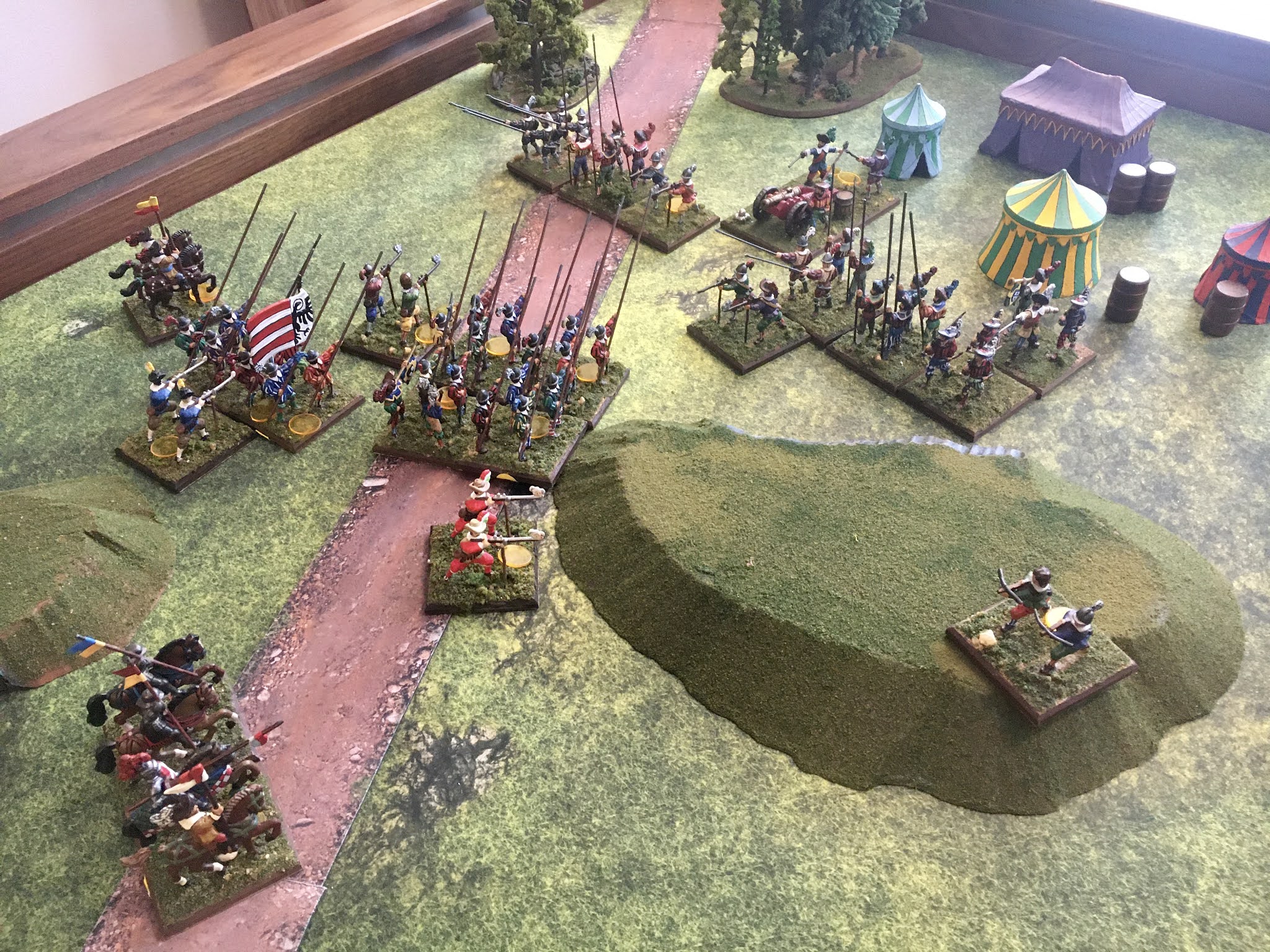
My sons and I got together yesterday on Google Meets (Hangouts is apparently dead) for a couple of games of remote DBA.  I hosted the first game, with the two of them playing, using my new Libyan chariot to command a Libyan army.  For those conversant with DBA, this is army I/7b, and I don’t have the figures done yet to provide any choices, so all the warriors were deployed as “auxilia” and there was a Sea Peoples stand rather than a second chariot.  There were up against later New Kingdom Egyptians (I/22b) whose only choice is whether to deploy the Sherden guard as “fast” or “solid” blades.  William was in command of the Egyptians and elected to make them “solid”.  A dice off for attacker/defender and for terrain left the Egyptians invading Libyan territory, so they were away from the water in a wilderness of rocky ground (represented by the brown cloth shapes) and a difficult hill.  Since we often have a hard time seeing things remotely anyway, we kept the terrain layouts pretty simple. If this were a convention demonstration game, it wouldn’t be hard to improve the table dressing. The Libyans deployed with most of their more capable troops to the left of the hill, and covered their right flank by deploying their skirmishers on the difficult hill.  The Egyptians were impeded somewhat by their need to carefully pick their way through the rocks and scrub.  They were deployed with most of their chariots out on their left flank in a bid to demoralize the enemy quickly by taking their camp.


Eventually the battle lines met at the edge of the rocky ground.  The Libyan swordsmen wilted under the hail of Egyptian arrows, losing one of two stands as soon as they were within range.  The usual DBA shoving match started, and the Libyans rapidly lost their fourth stand, ending the game.

I don’t know for sure what the screens showed at the far end.  For these family DBA games we have generally supplemented the  screen view with occasional cell phone pictures sent by text message, to clear up any difficulties in understanding the tactical situation:


We played a second game, with Arameans (I/6c) against Syro-Canaanites (I/20b) using Norman’s collection and board.


Unfortunately, however, for much of the game, it looked like that.  The Syrians (played by me) quickly rolled over the Arameans (William), aided by the fact that his general died in the first combat round in an attemtp to roll my army up from the flank before my chariots could make a difference.  As he said, in most games he’d have conceded right then, but we’d already be online for about two hours and I suggested that it would probably only take one more turn to actually decide the game by the rules.  I was right...

We wrapped it up after that.  I was glad to see my armies out; perhaps I’ll get a few more painted by the time we are ready for some face-to-face games again.


Saturday, September 19, 2020

Since Gencon Online ... catching up

It has been a bad month and a half for blogging, and a rather middling one for hobbies.  Hence, I have decided to go ahead and catch up on what has been happening lately.  

Inspired by Gencon, my brother was kind enough to run a Chaos Wars game on the 8th of August, with Ral Partha elves vs. orcs.  Run remotely from his house, I took the elves, and for the first time in a number of remote games, the home player (i.e. NOT me) won the game.  Chaos Wars makes a reasonable remote game; it doesn’t involve a lot of units (usually) and it’s not too fussy about geometry.


(Screen capture from my iPad near the start of the 8 August Chaos Wars game)

It was my turn to host a game the following weekend, and Ross Macfarlane and Norman, my older son, took command of my collection of 40mm home cast Renaissance figures for an “imagi-nations” Civylle Stryfe in Ardenn game.  We used Scenario 22 from C.S Grant and Stuart Asquith’s Scenarios for All Ages.  Without actually looking it up, it’s called something like “Best of a bad lot”, and involves a tired column running into an army in camp, so that neither side would have chosen to fight under the circumstances.  

Ross ended up with the column, as Duke Frederick (the usurper; see As You Like It, by the historian Shakespeare), and Norman ended up with the camp (the loyalists, commanded by Italian soldier of fortune Mercutio). We were trying out a new variation of the Rough Wooing home rules designed for 40mm home cast figures using 1 stand = 1 company of ~100 men.  This turned out to be fussier than expected, and perhaps need a few more tweaks. On top of that, it was not a scenario we’d tried with these troops, so my attempt to implement the scenario conditions and impose a mechanical penalty for the tired attackers was perhaps too much.  So, a reasonable game, but it could have been better.  As the central gamemaster in a remote game, I ended up too busy following both sides’ orders to take as many pictures as I would have liked.


The camp’s defenses (to the right) have formed up to meet the Usurper’s tired troops


Screen capture from the central game server...


Theat wasn’t a bad weekend for games; I also finally set up and played a Dragon Rampant scenario generated by my solo campaign, which had been awaiting resolution for several months.  The nice thing about a solo campaign is that the opponent doesn’t get bored while waiting for the next move to be resolved.

I used some orcs borrowed from Norman and some of my general purpose fantasy/medieval 1/72 scale figures to resolve an encounter out on the eastern borders of the human kingdom of Darmis. I ran the “Into the Valley of Certain Death” scenario from the rule book, in which both sides have stumbled into some inhospitable territory.  In this case, I considered it to be an area of traps left by the elves, who are happy to wear down either or both parties.


The board is supposed to have 50% of the area covered in scenery, and any unit entering a terrain feature for any reason takes hits.  The units were, for the most part, able to maintain control and stay out of danger, so I was glad to be playing solo. I don’t think that it would have been too much fun as a regular two (or more) player game.

Captain of the Darmish forces (upper right) faces off against two companies of orcs

Nevertheless, it wasn’t a bad way to while away a pandemic era afternoon, and the path was clear to resolve the next month in the campaign.

Norman provided the fourth (and final) game of the month on the 30th.  He has been working on various Bronze Age DBA armies, so we tried out his Sea Peoples (a new army to us) against the Egyptians. We played two sessions, because my Egyptians were quickly smashed by the Sea peoples in the first session, and I wanted to see it it was bad luck, or whether my plan was flawed, so we just did a partial reset back to the starting positions.  In DBA terms both armies are “Littoral”,  which gives them the option of an amphibious landing on their first turn.  We both reserved troops for this; switchin up the actual landing locations for the two games.  I lost the second game as well, though by a somewhat smaller margin, but I am nevertheless forced to conclude that my plan was probably fatally flawed. 😕 

There hasn’t been a game yet this month, so that’s it for recent games.

I’ve gotten a little bit of painting done.  Inspired by Gencon, I painted two more relatively random figures for my proposed Urban Fantasy game:


Leon is a Reaper Bones Chronoscope figure, rebased, and Lucia is a Hero Forge custom figure.  She’s a fae character of some sort, with faun legs and big ears, though dressed in imported human styles.  That’s hoof polish, by the way, not pink slippers.

The next time I sat down with a brush, I ended finishing up a stand of Hordes of the Things “beasts” for the Portable Fantasy Campaign, consisting of a Caesar Miniatures elf sorceress...


... and two Reaper Bones “saprolings” as tree creatures of some sort.  This is the second (of two) of these stands.  The first was finished back in March.  

For my most recent micro-project, I stayed with the 1/72 scale fantasy theme with some baggage and a camp follower/NPC.  While cleaning up recently, I found a group of figures I had washed prior to priming some months ago.  Included in the group was a small flock of sheep, which I had started when I did a campaign battle last October, for which I had needed three baggage train items for an escort mission.  I had two, and filled in the third with a mounted Maid Marian from the Airfix Robin Hood set.  The sheep are from the Pegasus farm animals set. I decided after I had started them that I wanted a shepherd of some sort, so another Robin Hood set figure was drafted for the purpose.  For figures the Plastic Soldier Review lists as having been released in 1964, they hold up very well considered alongside some of the modern manufacturers.  The pregnant woman came from the Linear-B/Strelets Roman transport set.  The review notes that her costume isn’t particularly accurate for Roman times, but she fits right in to the generic fantasy themed collection.


I’ve got several things on the painting desk this weekend, so I shall hope to finish something tomorrow.  I have been using the desk as my work at home space, and I will need to be cleared off again by 7:30AM on Monday.


Sunday, May 17, 2020

Death on the Nile, in Remote DBA


During the current  difficulties, I have been keeping in touch with the hobby by playing games remotely.  Happily, years of practice left us ready for this.  Yesterday, my sons had their turn, as I hosted a game for the two of them, separately remote.  Since younger son William acquired DBA 3.0  fall, we have had a resurgence of interest in the game, and older son Norman and I (well, mostly Norman) have been at work reshaping and extending an earlier 1/72 Bronze Age project to cover more of the possible armies of the 13th century BCE.  For yesterday’s game, we pitted the ancient Libyans (DBA Army I/7b) against the New Kingdom Egyptians (I/22b).

 I set up the iPad on a tripod, having recently acquired a tripod mount for it, and laid out the reversible 3x3 ground cloth on the desert side.


Norman elected to command the Libyans, and William was therefore cast as the Egyptians.

We had to use a spare Egyptian chariot on a sabot base in lieue of the as-yet-unbuilt Libyan chariot, and the camps were also improvised.  Of the choices that we could make, Norman elected to take an element of Sea Peoples “blades” rather than a second chariot, and William elected to deploy his Sherden guards as “solid” (rather than “fast”) blades.

The terrain system gave us a waterway along one edge (as the Egyptians, a “littoral” culture, were defending).  William chose to use his amphibious capability to land two elements, some Nubian skirmishers and a renegade Libyan warband, behind the Libyan line in a bid to capture the enemy camp.


The battle then commenced.  William’s amphibious force won an early advantage by destroying two of Norman’s right flank skirmishers, but faltered in their attack on the camp.  After a single attempt, the situation in the main battle demanded all of his attention and command pips.


There was a good deal of pushing and shoving along the left end of the Libyan line (the Egyptian right), and eventually Norman’s Libyan “warbands” came screaming down off the hill in a bid to destroy the Egyptian infantry (against which they had a quick kill capability).  He was in the unenviable position of attempting to hold off chariots with skirmishers while hoping for some luck with the warbands, and the dice were not with him.  A couple of turns into the main fight, William finally overcame his cold dice situation, and killed two elements out on his right flank for the win.  

The video quality was still a little underwhelming, so we supplemented it by taking and texting pictures of the situations on demand.  As a result, the game took rather longer than it would have face to face.  However, if there’s one thing that most of us have these days, it’s time on the weekends.  With side discussion, set up, and the like, we were at it for about two hours.  We all agreed that we need to gain a little more familiarity with the rules, as extensive play with the first edition of Hordes of the Things was tripping us up fairly regularly.

Next time, perhaps we shall dig out the 2nd Punic War figures; they haven’t seen a battle in several years...


Sunday, May 3, 2020

Catching Up a Bit — Scenery and Remote Games


I haven’t done well at updating my blog the past couple of weeks, but all is still well here under lockdown.  I am still finding myself too distracted to paint as I would like to, but I have gotten the big brushes and craft paint out and had a go at some scenery.  First up is another of the resin village buildings I’ve been working on, the “Trader’s Shack“ from Apocalypse Miniatures.     
Apocalypse Miniatures “Trader’s Shack”


I am looking forward to getting the village into a game; at three buildings plus the outhouse, it’s starting to look like something.  A fourth large building, the Apocalypse “farm house” is on the painting desk with some paint on it.

Last weekend I pulled out all of the 25mm scenery boxes, sorted, consolidated, and labeled, so I now have an empty 12 liter Really Useful Box earmarked (and labeled) for transporting scenery for away games, and all of the scenery pieces have a labeled box to call home, so that can be sorted back after use.
Scenery Organization in Progress
In the upper right corner of the organization picture, a tan ruined tower can be seen.  I think I acquired this from a dealer at Huzzah a couple of years ago.  The manufacturer had already gone out of business, so I couldn’t get one in the grays I usually use for scenery.  Since I found it while organizing, I was reminded that I should try repainting it.

Wartorn Worlds ruined tower repainted...

...and with a little vegetation added to enhance it.
Happily, the recycled tire material seemed to take paint well, and I am pretty happy with the enhanced piece.  Now that it looks like it fits in with the rest of the scenery, I hope to have it on the table soon.

Following the scenery sorting, I set up a game of Burrows and Badgers.


My brother joined me remotely, seen in the upper right where a clamp to mount my iPad to a photographic tripod had arrived to make remote gaming easier.

We ran B&B last year at Gencon, so I used two of the war bands I had statted out, printed, and laminated.  I took the unlucky Reynard the highwayfox with his new-fangled pistol, and Norman took Sir Caradoc, a noble dog of the old school.

Reyanrd’s camp about to be attacked; ruined doorway by Reaper
A roll for scenarios brought us an ambush of a camp, and Reynard was elected to be the ambushee.  While he actually had some success with the pistol, for a change, Caradoc personally managed to bring him to justice.  I was reminded that I have an unfilled appetite for some detailed skirmish gaming; I should do something about that.

Just before everything locked down, I ordered a Hot Wire Foam Factory kit and picked up some 2’x2’ sections of pink insulation board from the Home Despot to work on my scenery upgrade.  The first warm day we had, I took the foam cutter outside and sliced up a few test hills.

Hot Wire Foam Factory test output
I recently acquired a neoprene mat from Frontline Games to be the usual basis for miniatures in the gaming table.  I hoped that Woodland Scenics flock would be a reasonable enough match; otherwise it’ll be post-lockdown before I can use the sand and house paint technique.  When I flocked the first test hill, I found that I had misplaced the reserve stock of flock, so I needed to reserve what I had for miniatures.  It was close, but I thought that it might be improved with some mottling of other flock shades. 
Small test hill with a rocky section
Eventually the flock supply arrived. (Thank you, USPS, for continuing to work during this!)  I tried again, and thought that would probably do.

Multiple flock colors
With the remote game this weekend, I was able to open up the table, which has generally been in use as my partner’s work-at-home space, and set up a game, including the test hills.

Corner hill...2.5” will be the limit if I want them to be flush with the top of the well.

You can judge the overall results from the set-up picture.

Terrain layout for this week’s game
This week’s remote game was played by Chris Palmer, who volunteered to help me out by taking one side in a pending battle in my Northlands (usually solo) campaign.  I shall hope to get a separate battle report up for that, but the short version is that the defenders of the kingdom of Darmis defeated a detachment of raiders from the neighboring kingdom of Verdance.  The small encounter was played out using the Dragon Rampant rules, and the “Crystal Gale” scenario from the rule book.  With that out of the way, I can figure out what the other pending battle looks like, and then get on with the next month’s worth of map movement.

The leaders of the two forces meet in battle, with the local cavalry sending the raiders packing
  At least with a solo campaign, nobody else is inconvenienced if it takes a while to resolve the next event.


Sunday, April 12, 2020

The Pass at Gelbehuegel

In the summer of 174x, the Nth year of the War of the Western League, an army of the Pragmatic Coalition was advancing northward in an effort to lay siege to the city of Schluesselbrett, and perhaps cause the Archbishop to sue for peace separately.  However, the Archbishop had turned his defenses over to General Schachlaufer (reportedly a nom-de-guerre of the notorious mercenary general MacDuff).  Schachlaufer, whose coupe de lo’oeil seldom failed him, looked over the possible approach routes to the city, and chose to make a stand at Gelbehuegel, where the northward roads converged, and the then combined route ran through a defile which would allow him to make the most of his limited troop strength.

The battlefield, before the arrival of the armies. Schachlaufer’s line of deployment in red, roads used by converging Coalition columns in green, North to the top of the picture.
 He had available to him two brigades of troops, a native Schluesselbrett contingent of two infantry battalions, a battery of artillery, and a squadron of light dragoons, and an allied brigade of two infantry battalions and an artillery battery from Hesse-Hattemstadt (in blue coats) and a battalion of Saxe-Kirchdorf jaegers (in purple).

Later in the battle, but illustrating the deployment of the League forces, with Schuesselbrett troops on the southern hill, allies on the northern, and the light dragoons in reserve on the road

As seen in the illustration, he elected to deploy with his local brigade guarding the hill to the south (his right) and the allied brigade guarding the hill to the north (his left).  With the troops emplaced, there was nothing to do but await the approach of the enemy.

The plans of the Pragmatic Coalition that day were flawed from the outset.  Bad maps had led General Nordstrom (a distinguished Wachovian officer in overall command of the Coalition forces) to believe that two roads continued to parallel each other beyond the defile at Gelbehuegel, and that the actuals hills north of the town were less of an obstacle than was actually the case.  He had divided his forces into an infantry column (of five battalions of line infantry, a battalion of jaegers, and a battery of artillery) and a cavalry column (four squadrons of various cavalry supported by a battalion of veteran Wachovian line infantry and a second battery of guns).

Coalition infantry deploying and attempting to assault the northern hill
There was a great deal of confusion as the heads of the columns ran into each other in the streets of Gelbehuegul.  General Nordstrom found himself stuck in the back of the infantry (left) column attempting to bring some order to the chaotic situation.  At the front of the infantry column, his subordinate, General Adelmann, was the first to see that that the enemy had decided to make a stand at the defile.  He ordered the lead battalions of infantry to deploy and to attack the lower slopes of the northern hill, where the enemy artillery could be seen deployed, and the King Rupert Jaegers to attack the southern hill, using light infantry tactics to (hopefully) suppress the battery there, and allow the remaining infantry to deploy.  The attack was unsuccessful, and the Jaegars suffered fearsome casualties, pinned down by canister fire from the guns.

Visible at the top right, the Jaegers make their unsuccessful attack on the Schluesselbrett position

Meanwhile, on the Coalition right, the cavalry brigade, under the command of Prince Norbert of Schoeffen-Buschhagen, attempted to untangle itself from the traffic jam in the streets of the town. The Prince sent his light cavalry, a mixed lot of Hussars from both Wachovia and Schoeffen-Buschhagen, forward to see what could be done.  The S-B hussars gallantly attempted a charge against the gun position on the northern hills, but difficulties in traversing the terrain left them exposed to the fire of the guns, ably supported by the Saxe-Kirchdorf light infantry infesting the woods, for far too long, and they withdrew (a considerable distance, as it turns out) to the rear to regroup.

The Coalition infantry attempts to organize an attack

General Adelmann’s attempt to attack in the center was doomed from the start.  Coalition forces were unable to suppress the League artillery, and the entire area of fields north of the town were swept by artillery fire.  As each infantry battalion debouched from the tangled streets of the town and attempted to deploy, it was raked in turn by the deadly fire of the massed artillery.


The Coalition artillery finally reaches the battlefield, as the cavalry begins to clear the town

The provosts were finally able to untangle the mess in the town, and a lone Schoeffen-Buschhagen battery began to deploy, hoping to finally bring some fire onto the seemingly impregnable enemy position.  But it was too little, too late.  General Nordstrom, riding forward to view the situation, was appalled by the shambles left by the attempted infantry attack.  He ordered the General Retreat sounded.  The attack on Schluesselbrett might yet succeed, but not today.  As night fell and the guns fell silent, the battered Coalition army withdrew, to reorganize and perhaps try a more deliberate attack.
Remnants of the King Rupert Jaegers and infantry from the attack in the center stream off the field

Wachovian hussars withdraw, and the Wachovian infantry arrive, just in time for the retreat.


Monday, March 23, 2020

Dragon Rampant Remote Game — Raid on the Myzantine Frontier

My brother Norman and I took some time out of our busy schedules yesterday (ahem...) to play a game.  After our recent Cincycon outing, I was in the mood for more fantasy, so I suggested that we have a game of Dragon Rampant.  As I have mentioned elsewhere, an advantage of Dragon Rampant in a remote setting is that each player has a relatively small number of maneuver elements to concern himself with, and the exact angle and positioning of those elements is less important than the general idea of which other unit (or piece of terrain) their activation is intended to address.

My solo campaign has a battle pending which I have already determined will be resolved using the DR scenario “The Crystal Gale”, so I thought it might be interesting to try it with two players first, and my brother was agreeable.

Accordingly, I set up my 3x5 table with a little slice of the borderlands of the Myzantine Empire, in the northern reaches where it borders on the Orc lands.  (This is a bit of background from an unfinished fantasy map, intended to give some structure to my collection of older “true” 25mm figures.)

My first observation was that my table was too small to have much flexibility with respect to the placement of the objective markers (the royal crystals by the scenario write-up, reskinned here as information tokens).

The battlefield, as seen from the east, from whence came the Orcs

The battlefield, as scene from the west, from whence came the Myzantines
I chose two forces from my collection of figures which were all Ral Partha, out of respect to the inspiration provided by Cincycon.  The orcs, shown below, had a reduced model unit of elite foot as the warlord and his bodyguard, a unit of orcish heavy foot, a unit of goblin berserkers (bellicose foot), two units of goblin wolfriders (light riders downgraded to javelins rather than bows) and a swarm of rats (lesser warbeasts).

The Orcish force
The Myzantines had the Governor’s bodyguard (elite cavalry with the level-headed advantage), a unit of allied horse (heavy riders), a unit of heavy foot spearment, a unit of light spearmen (with added javelins—which never got thrown), and a unit of light archers.

The Myzantine force
We decided that we would use the rules that we have been putting off unit we were more familiar with the game, particularly the leader personality roll and the availability of additional victory points for the fulfillment of quests/boasts.  My brother, after seeing the army lists, elected to command the orcs. I rolled a leader who was immune to fear (less than helpful since no enemy unit caused fear), and my brother rolled a “commanding” leader who was allowed an activation reroll once per turn.  We randomized the direction of approach, as per the scenario write-up, and I ended up entering along the short side of the table partially behind the river, as shown above.

My second observation, as we got started with the game, is that it was going to be very difficult to reach objective/information markers when his force had faster units than mine, and he had an activation advantage.  

Nevertheless, we pressed on.

Orcish wolf riders advance boldly to open the action
I realized after the first two moves, when he already had 4 of 10 information tokens in the bag, that my only chance of pulling out a victory was going to be to succeed at my quests/boasts.  For me, that meant that I couldn’t afford to have anyone rout, and I needed to destroy more units than I lost. Since the game would end when the last information token was collected, I realized that I was going to have to leave one on the table and protect it in order to have a chance to beat up his units.

So, I attacked as quickly as I could with my elite riders, and followed them up with the allied horse.  The heavy spears were sent to the right flank to keep him from circling around toward the last objective marker, and the light spears with their javelins and the bows came up on the left to soften up his units for a decisive charge by the elite riders of the Guard.
The Governor’s Guard faces down the goblin berserkers
Norman’s rat swarm was subject to the Wild Charge rule, and they ended up getting into a protracted charge/response cycle with the allied horse, which wore both units down.  Eventually the allied horse were wiped out, but at least they didn’t rout.
Allied horse takes on swarms of rats


I got involved in the mechanics of running the game, and didn’t get a picture, but over on my right flank, my spearmen were under heavy attack by javelin throwing wolfriders, and even repulsed an unexpected attack by the orcish heavy foot, who waded across the river at a disadvantage to come to grips with them.  Eventually they were routed by the unanswerable rain of javelins.  It turns out that one of Norman’s chosen quests was to destroy that particular unit...
The Governor’s Guard in pursuit of the Orc Warlord and his Bodyguard
Having achieved his side quests and collected 7 of the 10 information markers, he decided it was time to withdraw.  As my only hope of losing less ignominiously was to pursue him, hoping to destroy another unit or two, I pursued with what I had left...my archers (who were very unhappy about being ordered forward), and the Governor’s Guard, reduced to half-strength. The warlord and his bodyguard, taking up the rear of the orcish force, exited well ahead of my pursuing cavalry.  Assuming that I got the two information markers left on the board, my final score was 3 minus 2 for the failed quests/boasts, a total of “1”, while he had 7 plus 3 for his quests, for a total of “10”.  Ouch.

However, the real primary objective, of taking my mind off of things for a little while, was achieved.  The total elapsed time was two hours, which left me with time to prepare dinner.

I’m sure that more remote games will be on the agenda in the near future.  I will try to take a few more pictures next time I’m hosting.