Showing posts with label wargaming. Show all posts

Wednesday, September 2, 2026

Midgard: Early Impressions


In late 2025 my son drew my attention to a post on the Lead Adventure Forum in which Jeff noted that he had recently moved to Delaware and wondered if there were any historical gamers about.  I sent him a note and we arranged a French and Indian War game just before Christmas, during my blogging hiatus.  As can be seen from Jeff’s blog, linked above, he’s interested in a variety of periods including ancients, French and Indian War, and Age of Sail, so we’ve had an interesting series of games since then.  

I picked up a copy of Midgard a while ago, based on the discussions about it online and the fact that its basing system is compatible with my 60mm square bases I use with my 25mm fantasy/historical mass battle miniatures. Jeff has been wanting to get his ancients on the table, and I have been wanting to try it out, so I eagerly accepted when Jeff proposed a few weeks ago that we test it out with a Trojan War game using his 28mm Foundry and Redoubt figures.  

Athena watches the Greeks…”Where did Odysseus get to?”

As with any new set of rules there was a lot of rules referencing.  I had read them when I first got them, but life intervened before the game and I didn’t end up rereading them, although I did rewatch some of Too Fat Lardies’ introductory videos.  There’s a lot of information on the net regarding Midgard’s mechanics, so I’m not going to go into them in detail, at least in this post.  Army morale is handled by a system of “reputation” points, which you lose by losing heroes and units, and gain by having heroes perform brave actions such as charging at the head of their troops or challenging enemy heroes to single combat.  At the end of a turn in which an army’s reputation reaches zero, they lose. 

Jeff set up the two army lists and we tossed for sides and attacker/defender status in an open field battle.  I ended up with the Greeks, so I figured I would give the system a test by charging into combat with Achilles, my best hero, and challenging Hector to single combat.  The overall result was that a lot of reputation was at stake, and Achille’s death (though after slaying Hector, keeping The Iliad historical, though not correct in all the details…) took the heart out of the Greek army and the Trojans won the day.

As noted, there was quite a lot of rules referencing, but the core rules are pretty simple. You throw dice for command tests and combat, and you have a 1/3 chance of failing a command test and a 1/3 chance of succeeding in a combat roll.  Movement rules are likewise simple; heavy infantry gets a full move if going straight ahead and half if doing anything else; skirmishers can move freely in any direction; etc.  We didn’t run into anything in the rules that really upset us, so we agreed to schedule another game.

Jeff’s DIY Trojan War reputation marker containers

We played a second game yesterday, using Scenario 2 from the book, “None Shall Pass”, and Jeff’s collection of Romans and Gauls.  This is an asymmetrical scenario, which the defenders having few troops, but defending two crossings of an otherwise impassible river.  After some discussion we assigned the Gauls the role of defenders and then tossed for sides.  I ended up playing the Roman attackers.  After considering the lessons from the first game we both played the leaders a little more cautiously; we charged with them to gather some extra reputation points, but avoided challenges to single combat.


Due to the limited avenues of approach I ended up with my light missile troops in the middle, shooting across the river and the heavy infantry assaulting the two crossings.  It was a slugfest, but Jeff was suffering from a case of cold dice, and the Romans eventually ground the Gauls down in the approved Roman manner.  Since the first game I had a chance to read the rules, so we only needed to look up more unusual and complicated situations.  Management of the leaders seems to be the key skill to the game, and I believe that’s what James Morris intends. I feel like one or two more games would put me in a position to fight the battle and not the rules, so I am anticipating seeing more of this on the table in the near future.  


I have plenty of fantasy figures I could use with these rules, as well as a large collection of 1/72 scale plastic Punic Wars figures.  Those would want some additional leaders painted up.  I think I’ve got a couple of extra Roman command stands painted up on speculation many years ago, but I am pretty sure I’ve only got one Carthaginian general painted.  It should also be possible to use a smaller collection such as my Dux Bellorum troops with a 6cm base width rather than a 12cm width, although that might make the 3cm half measure used in some places a little fussy.  It seems that some additional experimentation is in order.


Monday, July 20, 2026

More July Games

A Surprising Day for the Home Guard

 The week of the 5th of July was a busy on.  I’ve previously posted about the game day I had the opportunity to engage in with my elder son Norman on Tuesday the 7th.

On Thursday the 9th it was time for a HAWKs Geezer Game.  Duncan Adams has been hosting the Geezer Games since August 2016, shortly after he retired. However, I was only able to start joing in the fun in January 2025 after I finally retired.  These games are typically held from 10AM to 2PM, on the Thursday of weeks in which there isn’t a HAWKs meeting.  Many different games have been played across this series of get togethers, though we have been playing a lot of Combat Patrol since I joined up.

Duncan was playtesting a hypothetical scenario for Historicon for six players involving British Home Guard, a landing party from a German submarine, a downed aircraft crew and so forth, in a British seaside town. I ended up controlling a party of Home Guard (miniatures depicting the cast of Dad’s Army) and a group of shotgun-armed women of the Women’s Land Army.  Overall this was a fun departure from the usual straight-up WWII tactical games we’ve been playing.  I have always enjoyed a multiplayer game with hidden objectives, possibly at cross-purposes.   

The Land Army meets the Luftwaffe

While the Germans eventually succeeded in their overall mission of rescuing the one surviving aircraft crewman, my forces acquitted themselves well.  The women, in particular, accounted for three of the four crewmen, but the last one slipped out of range and a parting shot from the shotguns had no effect.  As the picture above shows, it would be nice if we could somehow play Combat Patrol and keep the table cleaner, but it is a somewhat marker-heavy game.

On Saturday the 11th I went back down to Norman’s house for a rare second visit in one week.  We had two games on our agenda.  The first was the Dux Bellorum game we didn’t play in our Tuesday get together. I checked my records, and the previous Dux Bellorum game we played was back in April 2024, over two years ago, so it is no wonder that the rules needed a bit of review.

British (Welsh) attack a Saxon camp

After some discussion we chose an attack on a camp as the scenario. I took the encamped Saxons, which allowed me a moderate advantage in my force balanced by a disorganized starting position.  Norman took a mostly mounted force of Welsh, the game’s collective nomenclature for post-Roman British with less Roman influence than the alternative Roman-British army list.  We noted that this ended up being reminiscent of  the raid on Catraeth in Y Gododdin, which may be better known to wargamers in its retelling by Rosemary Sutcliff, The Shining Company.  


It didn’t take as long for Norman’s force to come to grief as it did for the Shining Company.  We were reminded that cavalry just doesn’t have the staying power in this game to go toe-to-toe with infantry warbands for too long.  Nevertheless, it was a fun game, and we resolved (again) to play it again sooner than two years from now.  

Norman observed that the rules would be good for a Tolkien game, and I have been considering painting and basing some Prince August fantasy figures to populate such a thing.  I’m also reminded that it is a compact game; the base table size recommendation for using single 60mm wide bases as units would be 3’ by 4’, so it should fit on most dining room tables. We also had only six and seven stands respectively in the game, so it doesn’t necessarily require very many figures.  This puts it in the same category as something like DBA.  I wrote up a review after our first game back in 2012, but it might be worth doing a revised review on the basis of additional gaming.

After we cleaned up Dux Bellorum Norman set up the day’s main event, a Proxia battle also involving William, my second son.  


He chose a scenario from the Red Book (Grant and Asquith, Scenarios for All Ages), “Making the Best of a Bad Job”, in which a tired column of troops on the march blunders into an encamped enemy force while attempting to transit the table.  A battle ensues that neither party would have chosen. William took the role of the Occiterran commander and the encamped force, and I had the marching column.


At the end of the day, I had successfully exited some of my troops, but the casualties incurred in preventing William’s counterattack from cutting access to the road left me below the troop level need for a victory (i.e., I lost…).


It was an interesting game, and we are always glad to see Norman’s impressively painted Proxian forces on the table.

Following that game there’s been a bit of a hiatus.  I had planned to be visiting my father in Michigan, but moved up my trip by a day when he was having some issues and needed some help.  The planned visit precluded Historicon this year, but I’ll be finishing up the month with another visit to Gen Con. I hope there may be time for another post or two before the Gen Con After Action Report, but we shall see.  My brother and I are hosting four miniatures games at the convention, two each of Dragon Rampant and Burrows and Badgers.


Wednesday, June 26, 2024

Casting with Schneider Molds for a 19th Century Project

 Through a fortuitous alignment in work and holiday schedules I was able to get five days off at the cost of one vacation day last week.  Unfortunately for my plan of doing a couple of long bike rides, we were under a “heat dome” with record-setting temperatures, making that inadvisable. 

What I did instead was to set up the casting gear, as molds (unlike bicyclists) are benefited by extreme heat.


Since the last time I cast, I had acquired one of the remaining molds to make this project practical, by my rather whimsical standards, of course: a mold making a set of three Prussian/German artillerymen in the ~40mm scale.


I have two molds for cannon, a Schneider 74, and a WGW 5926. I have had little luck in getting a complete casting out of the Schneider mold, so I hoped that the hot day would do the trick.


As it was, I decided this was close enough and I would patch the missing spokes with greenstuff or hide them with some foliage.

I was a little surprised to pour a 95% complete (i.e. repairable) example of the WGW 5926 just as I was stopping for lunch one of the days.


I even managed to make some cavalry, although they will require some weapons repairs.


These are from Schneider molds 1 and 3, I believe.  

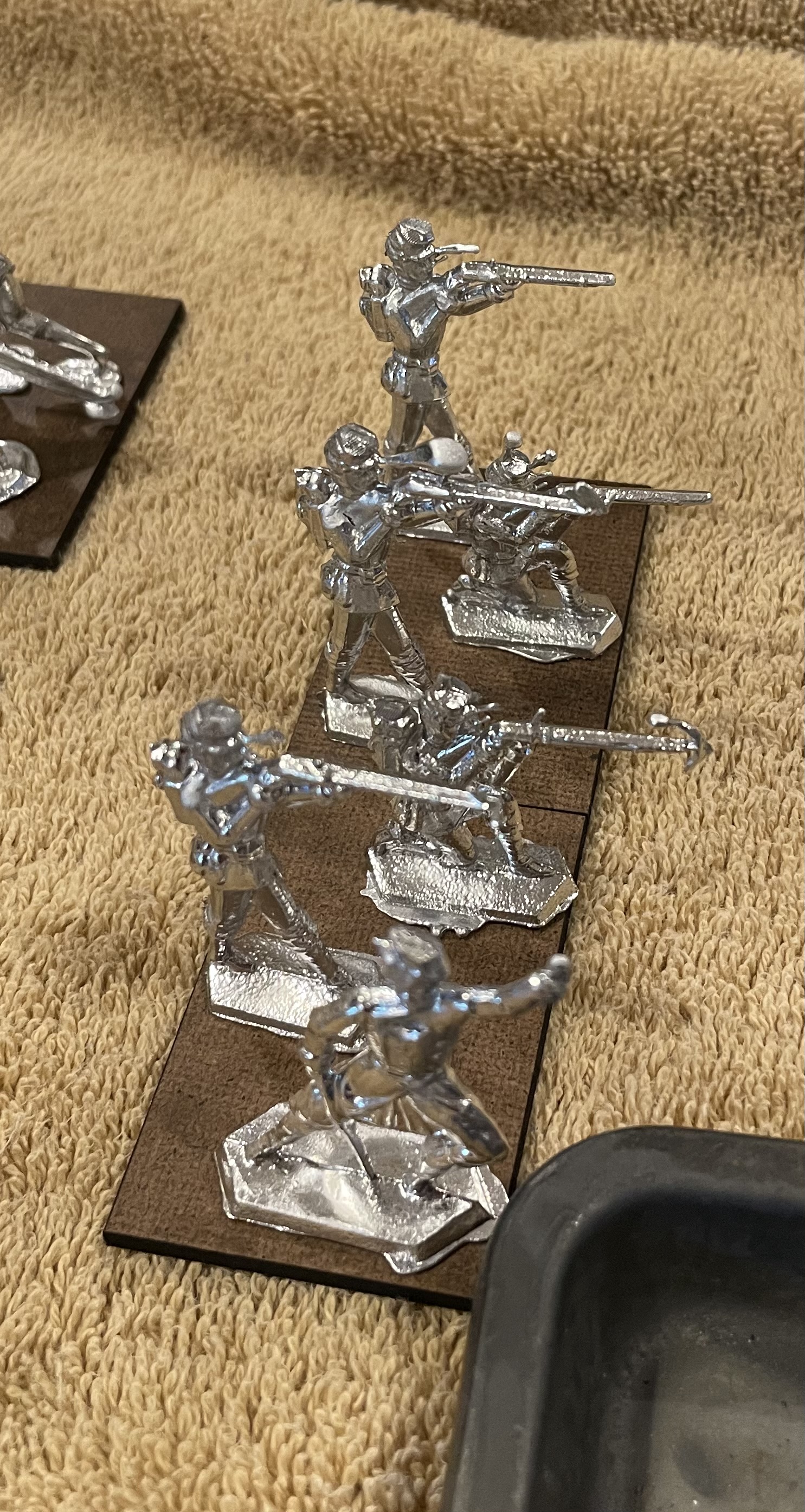
The infantry was generally casting well, particularly the standing and kneeling firing pairs, although some marching Prussians turned out to be rather fussy.  


With some figures cast in a previous experiment, three afternoons spent at this allowed me to cast enough figures for a French(ish) army and a Prussian(ish) army for One Hour Wargames, less one cavalry unit for each side. As can be seen in the basing mock-up picutres above, my plan is for each army to consist of 4 infantry units (each of 6 figures on 2 60x40mm bases), 2 skirmisher units (each of 4 figures on 2 60x60mm bases), 2 cavalry units (one only right now, consisting of 4 figures on 2 60x60mm bases),  and 2 artillery units (each of a cannon and 3 crew on a 60x80mm base). 

The Schneider mold series has a few “dramatic” figures.  I don’t yet know what I’ll do with the “falling wounded” or “clubbing with rifle” poses, for example.


Schneider had an extensive range of molds. (A link to their catalog can be found here.) I have some scenery molds, so while I was casting I decided to make a few more trees and try a sub-scale house mold I have.


As the fates will have it, the house proved remarkably easy to cast; I got three in three pours.  The tree mold is also very reliable.  I’m thinking for this project I’ll mount the trees on round bases and scatter a few over the cloth forest bases for appearance.  

My elder son gifted me with a grandchild last March, so we have been idly considering the proper age for involvement with our hobby.  Before that time, though, perhaps the Schneider molds could be used to produce a more pacific play set:


This is an assortment of Schneider farm animals, farm people, trees, and one of the houses (off in the distance with forced perspective 😆). The fence section is one of the cavities in the mold with the cow and the farm woman.  I also have a selection of Schneider zoo/wild animal molds.  I’d like to give them a try next time.  With the recent Not Quite Seven Years War games inspiring some work, I will probably need to haul out the gear sometime soon and fill out some partial units, so I don’t think it will too long before the next session.


Monday, June 24, 2024

The Perfect is the Enemy of the Good, or Two Recent NQSYW Battles

 This year continues to be a slow year for getting much done with the wargaming hobby.  I have not been painting much, and, at almost halfway through the year, I have a mere 11 games in the logbook.  That said, the two most recent games were both Not Quite Seven Years War Charge! games.  I have been delaying on getting them written up as proper fictionalized battle reports, and have decided this morning that something written would be better than the perfect report never set down.

The Bridge at Gehoelzkirche

The HAWKs hosted a game day on the 8th of June, and I volunteered to run a Not Quite Seven Years War game since I hadn’t seen the troops on the table in w while. Additionally, Ross Macfarlane  had sent me a contingent of troops from Rosmark during one of his bouts of downsizing, over a year ago, and they hadn’t yet been out.  I had a video chat with Ross to make sure I knew who was who, and arranged with Chris Palmer to borrow the North Polenburgers. I decided that the scenario would be “The Vital Bridgehead”  from C.S. Grant and Stuart Asquith’s Scenarios for All Ages.   This is a slight adaptation of “Sittangbad”, the example scenario from Charge!. I was a little startled to find that I had enough troops on hand to deploy the scenario using full regiments (~60 foot or 30 horse).  I set it up on a 6x12 table, and didn’t quite work out the movement rates vis-a-vis table size correctly.


Here in the foreground can be seen the small town of Gehoelzkirche.  As the scenario fell out, it was defended by a mixed force of the Northern Alliance (Rosmark and North Polenburg) who were falling back in the face of a superior force after a failed raid into Schoeffen-Buschhagen.  As they reach the town, they discover it is choekd with vital supplies which need to be evacuated across the bridge before the brdige can be destroyed.  In the farther distance, another small village is available to serve as a defensive strongpoint, and was garrisoned by a battalion of Rosish Pandours (light infantry for this game).  Two regiments of infantry and some supporting elements are in the open area between the two towns, and one regiment of infantry protected Gehoelkirche and the bridge.


The attackers, the Pragmatic Coalition, with four infantry regiments, three cavalry regiments, and various supporting troops needed to capture the bridge and trap the Alliance force on the wrong (west) side of the river if possible.  


Now, as referee I made a mistake in not allowing the attackers enough time to potentially get infantry across the table to interfere with the evacuation of the town and subsequent withdrawal of the troops.  It’s possible that the cavalry, if boldly handled and indifferent to the casualties, could have forced their way through the defenders between the towns, but this wasn’t put to the test.  The attackers spent a great deal of time attempting to force the Pandours out of the smaller town before finally compelling the Pandours to surrender.  As a delaying tactic, it worked brilliantly.  


With time to evacuate the supplies, the Alliance forces began to cross the bridge (led here by two squadrons of Rosish carabiniers) back into the safety of West Rosmark.  Overall, I wasn’t pleased with my lapse in scenario adaptation, but, other than that it was a fun and visually spectacular game.  I later calculated that we had about 630 home cast 40mm semi-flat figures on the table, which did contribute to some traffic james along the way. Perhaps I should paint up some Schoeffen-Buschhage provosts to direct traffic…

Encounter at Gaithersburg

Just a week later, on the 16th of June, I took the troops on the road to visit my elder son’s house.  For Father’s Day, we set up another Charge! game, this time using scenario #2, “Threat to the Flank” from Scenarios for All Ages.  Knowing that we would be using a 5x6 foot table, and having the recent time and traffic troubles in my mind, I decided that we would scale this down, and deploy Charge! companies and squadrons for the units, rather than regiments.

After the failure to trap the raiders at Gehoelzkirche, the Pragmatic Coalition was attempting to gain some advantage by continuing to pursue the retreating Alliance forces.  The Alliance chose to make a stand at Gaithersburg.


I took the part of the Northern Alliance, defending some high ground behind a shallow river.  The Pragmatic Coalition forces (mostly provided by Norman’s Wachovians and William’s Wiegenburgers) had sent a flanking force to their right to use a bridge further up the river to outflank the defenders.

They had a quick conference and decided to reject the scenario’s pre-set outflanking plan in favor of a frontal attack across the river and up the hill.  As it happended, the Wachovian regiment in the lead was shot up pretty throughly by the defenders, but the Wiegenburgers behind them were mostly screened, and successfully took the hill on the second assault.


What then amounted to a diversionary cavalry action at the bridge had no significant effect on the outcome of the battle.  


Overall, it was a fun (albeit short) game.  We probably spent more time deploying and packing away all of the indivisually based figures than we spent actually playing.  However, we had reservations for an early dinner, so everyone accepted the schedule constraints. 

The Future

At this point I had already submitted a notice to the organizers of Barrage (27-28 September) that I would like to put on a big Charge game, so we’ll be looking to fill a 6x20 foot table.  Various HAWKs are dusting off or expanding contingents that haven’t seen battle in years.  Perhaps we’ll see you there …


Monday, March 18, 2024

Fantastic Battles — A Review

 This winter has been a quiet season for my wargaming hobby, but I am hoping that spring inspires me to some fresh activity.

I thought I would get back in the game with a review of Fantastic Battles by Nic Wright. Fantastic Battles (copyright 2020) is a generic fantasy mass battle game.  It is available as a PDF from Wargame Vault for about $11, and as a POD hardcopy from Amazon for about $20.


In considering whether I am going to purchase a new set of rules the basing conventions are the first thing that concerns me. I have vowed to avoid rebasing my miniatures collections at all costs, so I became interested in Fantastic Battles when I learned (from discussions on the Lead Adventure Forum) that it was intended for troops based on squares with a small number of individually based characters to act as commanders.  60mm bases are recommended for 25mm figures, and 40mm for smaller figures. Conveniently, this is how most of my 25mm fantasy collection is based, so it would have seemed like looking a gift horse in the mouth to reject the opportunity to purchase and try these rules.  I should note here that there are also some minor suggested rules changes to account for the use of troops on rectangular bases.

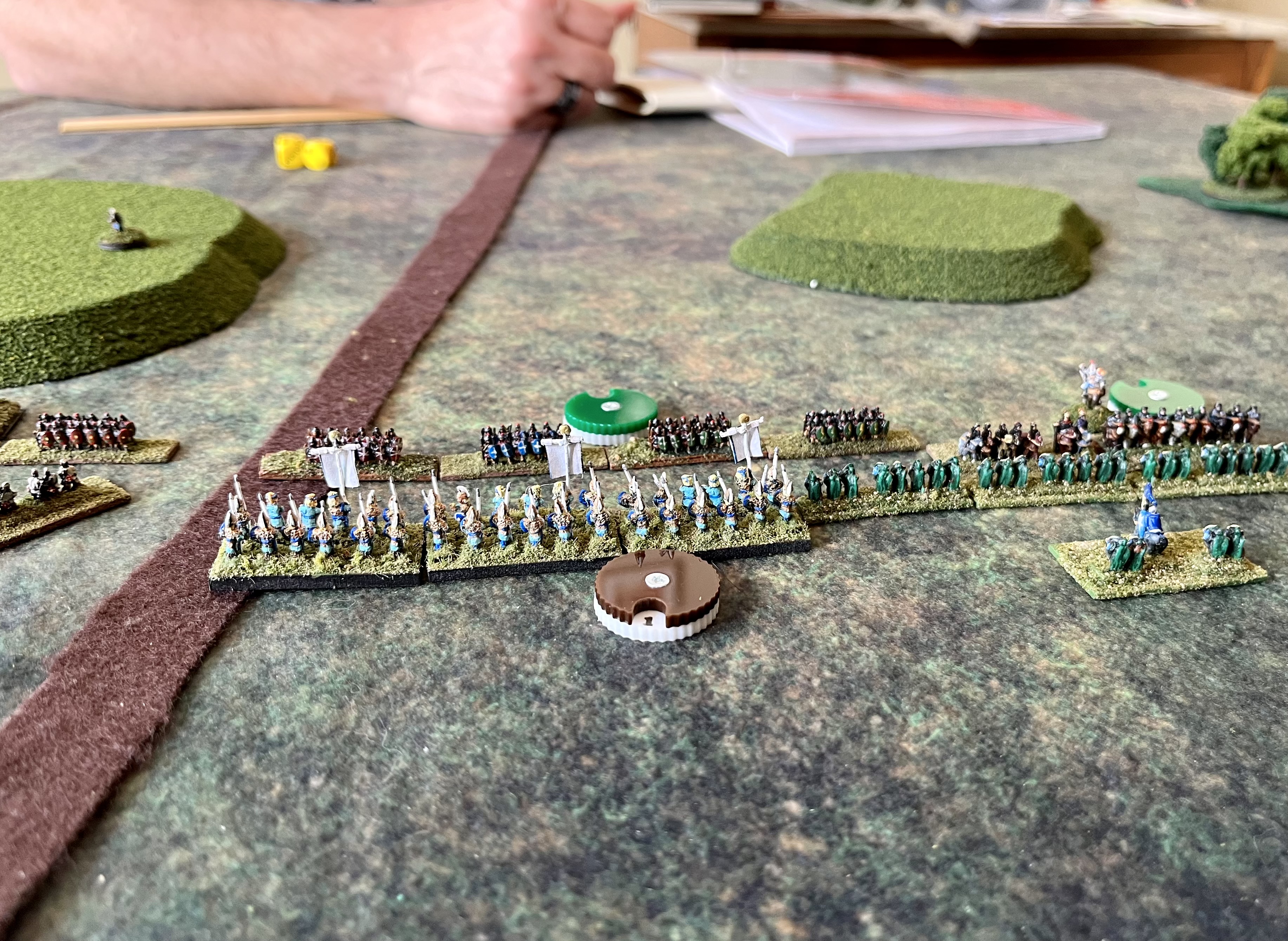
6mm Fantastic Battles with rectangular bases

The actual rules are about 40 pages long, including the lists of spells and unit attributes (“traits”) described below.  There are also four pages devoted to a short campaign system (to be played on a node-and-link map of areas and communications routes), a selection of twelve fantasy armies with points precalculated for suggested units types which cover the usual fantasy trops (humans, halflins, dwarves, elves, goblins, ratmen, lizard men, and undead) plus a set of twelve mostly historical army lists in six matched pairs ranging from Greeks and Trojans to Conquistadors and Aztecs. The book concludes with a two page quick reference sheet.

The rules describe themselves as “setting agnostic”, which is to say that there is no specific background given, and the army construction rules should allow you the flexibility or build whatever sort of fantasy army you like.  Each “company” (a single one of the square bases mentioned previously) is built from a basic type (elite, formed, irregular, fantastic beast, dragon, artillery, or vehicle) customized by adding some of the forty traits to it.  An army can have one overall defining trait (say “Drilled”  for Romans or Gondorians) and each unit can have up to three additional traits. For example, a company of knights might be an elite company with “mounted” and “furious charge”. Each company has five basic statistic: resolution (number of hits it can sustain), move (in base widths or “BWs”), melee (number of dice thrown in combat), shooting (number of dice thrown at short and long range), and defense (target number for an enemy’s attack rolls), plus a base point cost for purchase. The various traits will alter those numbers.  Mounted, for example, increases resolution, move, and melee, as well as increasing the cost.  There are negative traits as well. “Militia”, for example, reduces melee (and cost). Each company’s final statistics and cost are the sum of the base type values plus all of the selected trait values. Costs range from about 25 for an irregular company of goblin warriors to 50 or more for a company of elite knights.

The rules recommend playing with an army cost of about 750 points, and some points will need to be allocated to the command characters.  These come in four basic types, warlord, magician, captain, and rogue. They cost between 25 points for a captain or rogue and 75 points for a combined warlord/magician. So, a 750 point army might consist of three or four characters and perhaps 15 companies (with an average cost of 40).  The game recommends playing a battle this size on a table 30 BW by 20 BW.  For 60mm bases that would work out to be 4x6 feet.  For 40mm bases, a dining room table is probably sufficient.

Before the battle each player organizes his companies into units of one to four identical companies.  These units will be permanent for the duration of the battle. Units of more than one company may adopt one of three formations, line, column, and tortoise, and may change between them as needed during the game. These units pool the resolution points of all the component companies, so that a unit of four companies of irregular goblins at 3 resolution points each would have a total resolution of 12, and will be removed entirely when it takes 12 hits, with no intermediate removals of companies.  So you can organize your army into bulky units with good staying power, or smaller flexible units which are more brittle.

Each turn during the game will consist of three phases: shooting, actions (i.e. maneuvers), and melee. In the shooting phase, all companies with a shooting ability and within range of an enemy may shoot.  Shooting and melee both use the same dice system; a number of dice per shooting company is rolled, and any that equal or exceed the target’s defense value reduce the unit’s resolution.  Markers of some sort, or a roster system, will be needed to track hits during a game. At the end of the shooting phase any units which have taken more hits than their resolution rating are removed, so units always have a chance to shoot back before elimination.

In the “actions” phase, each player has a number of tokens in a cup (or cards in a deck). These are drawn one at a time.  The first draw for each player will activate all of their “impetuous” units, which is defined as those beyond the command radius of a character.  Impetuous units roll a six-sided die, and have a 50% chance of moving as the player wishes; otherwise they will be compelled to retreat, charge, or hold. After the impetuous units are dealt with, each draw will allow the player to activate one character and the units within their command radius. Units may perform various maneuvers; characters have additional possibilities such as spell casting or rallying troops. Enemy units about to be contacted by a unit of the active player may (depending on traits) be able to perform a response, such as evasion or countercharge.


Romans flanking the elves; note cards for initiative and dials to mark hits

When all tokens have been drawn and all actions completed, there is a melee phase.  All units in contact roll melee dice against the defender’s target number as with shooting.  Bonus dice are available for the usual sorts of situations, such as charging and flanking.  Successes reduce the target’s resolution, and, like shooting, destroyed units are removed at the end of the melee phase and therefore still fight back.

The mechanics are fairly simple and straighforward. Players with any background in wargames with miniatures should be able to oick them up quickly. Based on our trial games so far, players should be able to finish a 750 point recommended size game in under two hours, even allowing some time to look up a few rules as you go. The electronic version of the rules also includes an Excel spreadsheet which will calculate unit costs and allow you to print a basic army list.  I would recommend that you add a short description of the effect of any trait in your army with special rules (i.e., that involves more than a simple modification of the five statistics).  That would have saved us most of the lookup time in our trial games.

Despite my having purchased these rules to use with my 25mm collection, we have been playing the trial games so far with 6mm figures from Irregular (mostly) on 40mm WRG bases of varying depths, using the suggest rectangular base modifications.

Overall, the games we have played have been fun. I would recommend these rules if you need a rank-and-flank set of mass fantasy battle rules which provide a good two-player experience in a game lasting less than two hours and playable on a 4x6 table (in 25mm; your dining room table in smaller scales). We have not tried a multi-player game. I don’t expect that I will be using this for a six to eight player convention game to fill a four hour time slot. I note that my opponent thought our first game was enough fun that he immediately ordered a 6mm elf army from Baccus and has been painting it…


Saturday, November 4, 2023

October Wrap-Up


In keeping with the now-traditional hobby theme of “Orctober”, one of my projects this month was a plastic 54mm orc from the Toys R Us “Mythical Warriors” bucket.  


There is only the one pose available, and I have a dozen or more of them available to work with.  I don’t intend to do too many of these fantasy figures, but my goal is to try to make each one unique. The easiest quick change seemed to me to be re-arming them.


We had one late warm day a couple of weeks ago, so I thought I would try a very abbreviated casting session.  In my collection of molds, I have a weapons sprue for the Britains knight molds originally sold by Castings, and now back in production from Dunken.  To my surprise, the first pour into the mold came out nearly perfect, minus a shorted haft on the spear-thing.  


So it was not difficult to choose three more orcs and give them different weapons.  I intend to play around a little with shields and an arm repositioning, but haven’t gotten there yet.  While I was digging around in the molds and castings boxes, I came across a reasonably complete example of the knight on the left from this vintage metal mold. 

The upper left corner of the shield didn’t fully cast, so needed a little greenstuff repair.  However, I was glad to be able to put one of these into a (potential) game and therefore have an excuse to justify owning this mold.  (For the future, I note that the knight on the right, shaking his fist at the enemy, could be given a weapon from the replacement weaposn sprue as well…something for the spring.)


Earlier this week I was able to base the figures from the Italeri tournament set (i.e. the budget challenge project), the home cast knight, and another figure from the “Mythical Warriors” bucket.  I looked over my storage situation recently, and concluded that the 54mm fantasy will probably go beyond the approximately ten spaces currently empy in my 54mm Medieval Boxes.  The upper limit would be to add one more 11-liter Really Useful Box, which would have space for 56 40mm square bases.  So, we’ll see …

Monday, October 23, 2023

Gaming Weekend and Some Painting

I have had a couple of busy weeks since I last posted anything.  I flew out to visit my brother for a few days the week before last, and we did quite a bit of gaming.  We ended up playing six games of Dragon Rampant, trying all of the scenarios in the rulebook, and also found time for a couple of games of Burrows and Badgers.


 I was flying on Southwest.  They have been adding more Boeing 737-800s to their fleet.  If you wonder why I would pay attention to a detail like that, the 800s have a new configuration of the overhead luggage racks, one that tilts your bag at a 45 degree angle in flight.  My magnetic storage box configuration calculated to fit in the overhead rack is not guaranteed to hold the troops steady if the attendant slams the bin shut at an angle. For this trip I decided I would be safe and limit my troops to a package of 2 4-liter Really Useful Boxes, which will fit under the seat. I could do this because I knew that my brother had plenty of terrain, so I didn’t need to bring any.  One box had the Burrows and Badgers collection, and the other had the selection of vintage fantasy figures shown above.  Without using too many reduced or single model units, I was able to deploy three different warbands over the weekend, without too much overlap.  I figured later that I could have done an opposing pair as well, but my brother has plenty of his own figures he wanted to see on the table.  As it worked out, I was glad that I did this. While the trip out to Indianapolis was on a 737-700 with the older style overhead bins, the trip back was on an 800.  For the future I would like to play around with fitting scenery into a 4-liter box, so that I could safely fly with one troop box and one scenery box and have a pickup game for a convention, or even a multi-player skirmish.


We played the Dragon Rampant games on his 4x6 Alpha Gaming Table, using a lot of Monster Fight Club scenery.


Here my Broadsword Miniatures rangers (ca. 1980) defend a Monster Fight Club rocky hill…


Here a pair of old Adina giants (not very big ones!) attack my brother’s early Ral Partha sea elves…


And some anthropomorphic animals scuffle amid the ruins in Burrows and Badgers…

It was a good visit overall, and I hope that we will have the opportunity to do it again sometime relatively soon.

Since the last update, I have picked up the brush again after unintentionally taking a couple of months off. As I previously noted, I started down the path of building a 1/72 medieval skirmish on a budget as a challenge. (It’s also compatible with the existing 1/72 fantasy figures, so doesn’t need to stand completely on its own).  My sons and I got together for a painting day this weekend, and I made some additional progress on the budget project:


Painting with a limited color selection and some cheap Chinese brushes has turned out to be a bit of a challenge, so I will have more to say about that in some future post.  In the meantime, I am compromising a bit; for budget purposes, you could mount these figures on pennies and use sand and paint for basing, but I am going to base mine on composite Litko wood/flexisteel bases so that I can use my magnetic boxes for transport.  More to follow on that …