Showing posts with label D&D. Show all posts

Monday, August 31, 2026

The D&D Experience


A while back, our neighbor expressed an interest in trying Dungeons & Dragons, because she is a fan of The Big Bang Theory.  Personally, I’ve only randomly seen a handful of the shows, generally when someone else was watching them, but I dug in a bit to see what sort of experience she was expecting.

After some consultation on various roleplaying game Discords, I came to the conclusion that the key elements were likely to be rolling some d20s (and other polyhedral dice), doing a bit of roleplaying (i.e. light improv with character voices), anf fighting a battle on a battle mat or some sort, and that we’d probably be good as long as it said D&D on the box. I also concluded that the whole thing would flow more smoothly if I didn’t have to stop and look up the rules, so I went retro and ran with original Dungeons & Dragons plus some of the rules from the Greyhawk supplement and abandoned any thought of trying to play 4th or 5th editions, both of which were used on the show.  I don’t like to risk using my original books at the table, but I have the 2014 40th anniversary reprint to use as a table copy. (I was appalled at what a 2014 set went for the in Gen Con auction last year, but I need to use something…)

We recruited one of the neighbor’s friends, a recent college graduate with some 5th edition experience, and my wife to round out an adventuring party.  They agreed that pregenerated characters would be acceptable, so explaining character generation was one more thing off my plate.  

Heritage Dungeon Dwellers, from sets 1206, 1207, and 1208


For my own amusement I decided that I’d staff the game with vintage miniatures since I was using vintage rules, so our player characters, a fighter, a magic user, and a cleric, were chosen from Heritage Dungeon Dwellers from around 1980. 

Miniatures loaded for transport

The opposition was provided by some Minifigs ME  “man-orcs” and “true orcs”and it doesn’t get more vintages than that, as they were the first range of fantasy figures. I also turned out to need a baby dragon, so I dug into my (mostly organized) boxes of my vintage “pile of potential” and came up with one from Heritage, a #1005 from their Dragons range, released just before they went out of business.  Drawing on


my somewhat rusty speed painting skills, I got him ready in about an hour and a half all told.  It’s the first figure I’ve painted in months, so I am hoping this will help break the painting block.

I kept with my vintage theme in setting up an adventure, and started the characters in Stoneharrow, the main town of my first D&D campaign.  Rumors reached them of a nearby village troubled by goblin raids, and of a reward for driving off the goblins.  I wouldn’t ordinarily set things on rails to this extent, but I wanted to get in a few set-pieces that would provide that “D&D experience”.  So I wanted the scenes to be “visit the village”, “fight with the goblin lookouts”, “explore the cellar”, and “the arrival of the dragon”.

Notes for the adventure, kept to two A5 pages

I set the pregenerated characters to be 3rd level to give them some survivability and each of the players chose the class that seemed interesting to them.  I also threw in a 2nd level fighter henchman so that the magic user might be able to avoid getting into a hand-to-hand fight with the goblins.


We finally gathered this past Saturday. After some final preliminary work to pick some spells, our brave adventurers crossed the Great River on a ferry, arriving in the little village of Barl’s Landing.


They roleplayed their way through an encounter with the village leader and the innkeeper, and collected some information about the goblin threat, including a rumor that an ogre was also about, and that a dragon had been seen flying over the area.  When they eventually headed for the ruined tower that the goblins were using as their lair, I pulled out a Dungeons Pop piece from my toy collection.  This came from a Kickstarter which did eventually deliver after many delays, and I was glad to put one of the pieces to use.


Scene reconstructed later

They found the tower, with a few goblin pickets visible, and quickly came up with a plan to distract them on one side while the rest of the team snuck up on the other.  That’s when they discovered that the guards also included an ogre.  So, the magic user put the ogre to sleep and a quick fight left them in possession of the upper works, although a dying goblin fell through an open trap door to alert those still below.  They hastily blocked the trap door with the ogre’s body, and debated their next course of action, and whether it was likely that there was another exit from the underground works.

We removed the tower for convenience; goblin counterattack in the lower right

As it turned out there was, so the goblins attempted to charge up the hill and clear our brave adventurers back out.  Everyone looks deep in thought above as they decide what to do.

The adventurers decided to pull together a hasty defense, and meet the goblins.  This turned out well for them, as they killed several goblins immediately.  I decided I’d check morale for the goblins, who broke and ran, leaving our heroes in possession of the field.  Since we were running short on time, we skipped forward to the part where they acquired the baby dragon from its cell and brought it to the surface, and we wrapped the evening up with the encounter with the mother dragon, who agreed that she now owed them a debt they could collect at some future time.

Our players and their miniature adventurers

If we ever decide that this isn’t a one-shot and that we’re continuing on, we have several threads we can follow up, such as the dragon debt, and a map of other goblin hideouts in the area which could be of use to the local authorities.  

Everyone had a good time and stayed engaged, and our neighbor noted that she now understood how one of these sessions could go on all day.  I was pleased that they were creatively problem solving by the time we were done, and that they noted and discussed several incidents in which the non-combat utility spells they hadn’t chosen would have been perfect, so they were also creatively engaging with the rules.  (I didn’t set that up, by the way.)

One postscript on my choice of the original rules:  I showed my wife a 4 page character sheet I’d been using in my most recent 5th edition game, and she agreed that that would have been overwhelming.  I don’t know what the Wizards of the Coast D&D start sets look like these days, but I hope they are considerably simpler than the base game.


Monday, January 24, 2022

Some thoughts on the hobby for 2022

 2021 was a bit of a slow year for gaming.  I am hoping to have a bit more fun in 2022, and have been thinking about what that might look like.

I have been trying to separate my desire for painting from any particular “get a game ready” goals, figuring that everything that gets painted will be used sooner or later, and there are enough periods and projects that are already “table-ready” to keep me pleasantly occupied painting.  That said, it would be nice to finish up the Bronze Age Nubian DBA army I started over the summer:


I would also like to add a few units (mostly specialized troop types) to the Not Quite Seven Years War. The last unit I added was an artillery piece and crew back in 2018 (or 2019 …).


  I started a group of six Prince August figures which are intended to be a light infantry detachment (for the reduced scale rules we have been using lately), but I’m still a painting session or two from finishing them.


I also have various 1/72 plastics ready to hand to fill roles in the Portable (solo) Fantasy Campaign, and a selection of vintage 25mm fantasy figures.  So whatever gets done will be good.  I had a nice string of “one figure per day on average” months, but it does look like January is going to be a break in that chain.

I did no casting in 2021, although I bought a fair number of used molds.  I would like to start casting again, when the weather is warm enough to work outside, and figure out which of the vintage Schneider molds will cast reliably.


That will allow me to decide whether I will be doing a mostly historical toy-style Franco-Prussian War project, a 19th century imagi-nations project, or neither.  I hope that this effort will resemble my 2020 project to cast from all of my old Prince August fantasy molds.  

As far as gaming goes, I have accumulated a stack of new rules that I would like to try.


I’ve also got a few older favorites (e.g. Knights and Magick) which I would like to dust off and get on the table.

I also have the ongoing solo fantasy campaign to play with, and am considering what it would take to put together a workable campaign on some sort. I suspect that the KISS principle needs to be kept firmly in mind…

I’m currently in a Dungeons and Dragons (5th edition) game, which has been running approximately biweekly.  I have posted a few things about my interest in reviving my original D&D campaign, so it seems likely that there will more RPGs this year.  

The elephant in the room, though, is downsizing.  I’ve accumulated more than I can reasonably expect to use, as each shiny new thing flashes in front of me and captivates me briefly.  Norm, over on his Battlefields and Warriors blog, has described his downsizing, and I need to take a serious look this year at what I can get done, and get some of the excess moved on to people who might be able to make use of it.  


Wednesday, December 29, 2021

A regional map for the Original D&D Campaign

 I showed off some of the material from my original D&D game back in April. While I had hoped to revive a D&D game this year, I ended up involved in a D&D 5th Edition game with a set of HAWKs players instead.  Nevertheless, I am still working toward actually doing this.

So, I took a few potential hobby projects with me, to fill any potential down-time during the family Christmas get-together.  Happily, there wasn’t a lot of that, but what time I did have I spent on drawing the Myzantine Empire map.

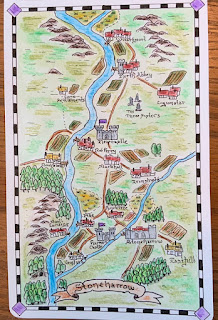
Since I was on a roll, I decided I would pull something off my D&D to-do list, and draw a more decorative map of the region in which the adventurers will be based.


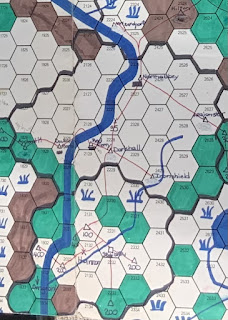
My original maps were drawn on SPI hex paper in the late 1970s, before I had done much reading in medieval demographics and agricultural history to get some sort of “realistic” grounding.  I ended up a little skewed (perhaps not inappropriate for a map which probably doesn’t owe much to surveyors), but attemtped to translate approximately the section above into a more fantasy style:


As with the Myzantine Empire, I added color with watercolor pencils, again deliberately keeping the colors somewhat less saturated.  I think this will do for a player handout … now I just need some players.


Sunday, April 18, 2021

Dungeons & Digressions

It was brought to my attention this morning that yesterday was an important day in D&D history, since Dave Arneson (according to his club zine) scheduled the first Blackmoor game, described as a “medieval Braunstein”, on 17 April 1971.  With that in mind, I hope that this digression from miniatures for a bit of personal D&D history is of some interest.

As I have mentioned before, I was a wargamer with both miniatures and board games before D&D was published, though a young one without too many opponents available to me.  There is a long-running Original D&D discussion forum of which I have been a member for some time, and there is often a lively discussion about how we managed to play the game back in the day, given that the rules (at the beginning) were somewhat in the nature of some broad open-ended suggestions.

Here’s what D&D Book III, The Underworld and Wilderness Adventures, has to say about setting up your campaign:

The so-called Wilderness really consists of unexplored land, cities and castles, not to mention the area immediately surrounding the castle (ruined or otherwise) which housed the dungeons. The referee must do several things in order to conduct wil-derness adventure games. First, he must have a ground level map of his dungeons, a map of the terrain immediately surrounding this, and finally a map of the town or village closest to the dungeons (where adventurers will be most likely to base themselves).


There was a discussion about whether there were actually towns, so I pulled out my binder of preserved campaign material from my original game.  I knew that I had a map of the town of Stoneharrow, drawn pretty early in the campaign preparations.  Given that the example campaigns mentioned in the rules, Blackmoor and Greyhawk, both had names in the form of “adjective noun”, I did the same in coming up with the name of my town, which then lent its name to the campaign.


So there we have the palisaded town of Stoneharrow, with quite a bit of open space within the walls where the peasents (sic) could grow vegetables in peace.  In retrospect, except for peculiarities in urban planning (a subject which I researched in much greater depth much later), I am not dissatisfied with it even now.  There are two named taverns, where mysterious hooded strangers might helpfully lurk in corners to hand out quests (though we didn’t actually do that at the time), boarding houses for adventurers segregated by class, a stable for their beasts, an adventure supply store for all your dungeon outfitting needs, an alchemist, and a temple of the local patriarch (in case you might need to be raised from the dead). I don’t know that the characters ever spent much time wandering around there, but the roots of adventure are there, should they be needed.  I am considering a retro game once the pandemic has ended, and I think that I will go ahead and build on this, by adding a few more non-player characters, and giving the poor patriarch a name. 

My favorite writing tool at the time was the Bic 4-color pen, and all of the early material was drawn on 10 square to the inch graph paper.  (I wish that I was getting a sponsorship reward, but I might note that I am still a fan of multi-pens, thought my favorite these days is this fine point Jetstream pen, which also includes a 0.5mm lead pencil.)

Since I was leafing through the binder, I also took a look at the dungeon.  Level 1 (below) is the actual carefully preserved first dungeon map I drew, in which the first dungeon expedition was undertaken by my brother, probably in April 1976.


Like the town map, it was drawn on 10 square to the inch graph paper with the 4-color pen.  I have heard assertions over the years that the early dungeons were intended to be mapped so that you could deduce the existence of secret rooms and such, but the 10/inch paper gave me plenty of room to draw, and I had a lot of solid rock in between rooms and corridors. 

There was quite a bit of space on the sheet of paper when I was done. Later, as the levels were elaborated, I added a level 1.5(B) to the same sheet, and using the same color conventions (black walls, blue secret doors, green room numbers).  Within a few levels, I shifted my color conventions, and eventually habitually drew levels with blue corridors, black cross-hatching marking solid interstitial rock, and red room numbers, like this later level:


For all of the elaborate labyrinth drawing, the actual key was pretty rudimentary.  Here’s an excerpt from the original level 1, down in the lower right corner:


Elsewhere, the book shows evidence of room contents being crossed out as the rooms were entered and cleared. The presence of an unguarded treasure including a pair of Gauntlets of Ogre Power in Room 62 would indicate that nobody ever got to that particular corner of the dungeon, probably because they had found a stairway down to deeper levels. From some of the discussions on rpg.net, I get the impression that modern players have a tendency to clean out levels entirely.  

I did my best to stack my dungeon levels in such a way as to try to avoid overlapping them in theoretical three-dimensional space.  So I did have a diagram on a large sheet of 10/inch graph paper with the relative position of all the entrances laid out.  There was one set of stairs, and a selection of shafts, mostly leading directly to deeper levels.  What there was NOT was any indication of what the surface terrain looked like. When I go back to this, I think that there will be a fence around the entrances, and a set of guards who will collect your entry fee and log your names and, for an extra fee, be ready to send notice to your next of kin if you don’t return.  The local lord will also demand a cut of your plunder, in proper medieval style.  But, back in the day, we were pretty casual about getting to the dungeon entrance.

My wilderness map evolved over time. The rules books refer you to Avalon Hill’s Outdoor Survival for “offhand” wilderness adventures, and the monster encounter tables are keyed to the Outdoor Survival terrain types.  I did not personally have a copy of the game, but one of the other group members did, so it seemed obvious to me that the expectation was that you would draw your own map. Hex paper was not easy to come by in 1976.  My first tiny section of the area around Stoneharrow and the dungeon was drawn on “hex paper” made by drawing circles around a coin in a hexagonally close-packed configuration. That map does not survive.  It was replaced by a second map, which also does not survive, which was drawn on a copy of an 8.5x11” blank hex sheet which we scavenged from someone’s copy of Fact and Fantasy Game’s Siege! (in fact, the blank sheet can be seen on the linked Noble Knight illustration of the game).  I attempted to fit several of these copies together, and they were not quite regular, so I had corners that didn’t match up.  After that, I bit the bullet and ordered a package of 6 blank hex paper sheets from SPI, the size of a standard SPI wargame map, and transferred the earlier map. Since the players hadn’t wandered around much, I’m not sure that they would have noticed any transcription errors anyway.

Here is a closeup of the area.  The dungeon entrance is in hex 1933, across the Great River from Stoneharrow (hex 2231), and Lord Harmon’s castle is between, in hex 2132.  All of this was considered to be at the standard recommended 5 miles per hex.  If I were running a game in this region today, Harmon (or his heirs—it’s been 45 years, after all) would certainly be monitoring the comings and goings of adventurers, and making sure that he collected his cut.  


Eventually the wilderness map was elaborated onto all six sheets of the hex paper, of which this one, the Stoneharrow map, was originally the upper right corner in a 2 wide by 3 high array.  Additionally, several of the original players advanced in level to the point where they built their own castles, which were duly drawn onto the map, generally north of the area including Stoneharrow.


I don’t recall how long it took, but I eventually added three more packs of paper, for a total of 24 sheets in a 3 wide/8 high array. In our house today, there is no room large enough to lay it all out at once, but here is the northern half.  The Stoneharrow segment is now the second map from the top in the right hand column.


There are a few geographical peculiarities that are partly the result of my earlier lack of a sense of geography, and partly a result of usually only being able to deploy one map at a time for drawing.  I can remember that I occasionally set them up in the lounge of the dormitory I lived in during my first two years in college (fall 1978 to spring 1980), and that I was still drawing the southern half up until graduation in 1981. By then, we had shifted over to the AD&D rules for the actual game.  I went through a lot of blue, brown, and green magic markers.  Each map is 32” wide by 21” tall, so the whole array laid out would be 96” wide by 168” tall, or 8 feet by 14 feet.  At 60 hexes wide by 32 hexes tall per sheet, that’s a total theoretical area about 900 miles by 1280 miles.  Let’s just say that this was seriously a lot more than was needed to play the game, and most of it was only very lightly described.  

With this year marking the 45th anniversary of my own D&D game, I am still hoping to stage a little revival, and send a party or two back into the Great Dungeon of Stoneharrow, using the original rules as first acquired, without Greyhawk or any of the later supplements.  We might even dig out (recently painted) examples of the early Minifigs lines (Mythical Earth and Sword & Sorcery) to represent the adventurers and their opponents. 


I did a brief revival campaign back in 2015 or so, and advanced the official timeline the forty years since the original game had begun.  The original characters were occasionally alluded to as the local lords whose neglect of the current situation was allowing goblins to menace the local village.  When I go back to this, I’ll probably continue on from there.

My first campaign ran from 1976 to 1979 using the original rules.  We shifted over to the AD&D rules (at least theoretically) following the publication of the vital excerpts from the Dungeon Masters Guide in Dragon #22 (February 1979) but before the actual DMG was available late that summer.  We continued to play until I moved to Maryland in 1982, but have dusted off the characters during occasional reunions, most recently in 2013 (although we did fight a theoretically linked mass battle using Chaos Wars in 2017).


My second campaign, in Maryland, ran from 1982 to 1985 or so, and was based down in the southwest corner of the overall map, so some of that drawing was eventually put to use.  Eventually other games edged out D&D for play time, and I got back into historical miniatures as my main hobby outlet, but, as you can see, D&D was carefully preserved and stored away, awaiting a return.

So, thanks to Dave Arneson and all the Blackmoor crew, for originating this pleasantly all-consuming activity that has given me so many friends and so much pleasure for three quarters of my life (so far).