Showing posts with label 19th century. Show all posts

Wednesday, June 26, 2024

Casting with Schneider Molds for a 19th Century Project

 Through a fortuitous alignment in work and holiday schedules I was able to get five days off at the cost of one vacation day last week.  Unfortunately for my plan of doing a couple of long bike rides, we were under a “heat dome” with record-setting temperatures, making that inadvisable. 

What I did instead was to set up the casting gear, as molds (unlike bicyclists) are benefited by extreme heat.


Since the last time I cast, I had acquired one of the remaining molds to make this project practical, by my rather whimsical standards, of course: a mold making a set of three Prussian/German artillerymen in the ~40mm scale.


I have two molds for cannon, a Schneider 74, and a WGW 5926. I have had little luck in getting a complete casting out of the Schneider mold, so I hoped that the hot day would do the trick.


As it was, I decided this was close enough and I would patch the missing spokes with greenstuff or hide them with some foliage.

I was a little surprised to pour a 95% complete (i.e. repairable) example of the WGW 5926 just as I was stopping for lunch one of the days.


I even managed to make some cavalry, although they will require some weapons repairs.


These are from Schneider molds 1 and 3, I believe.  

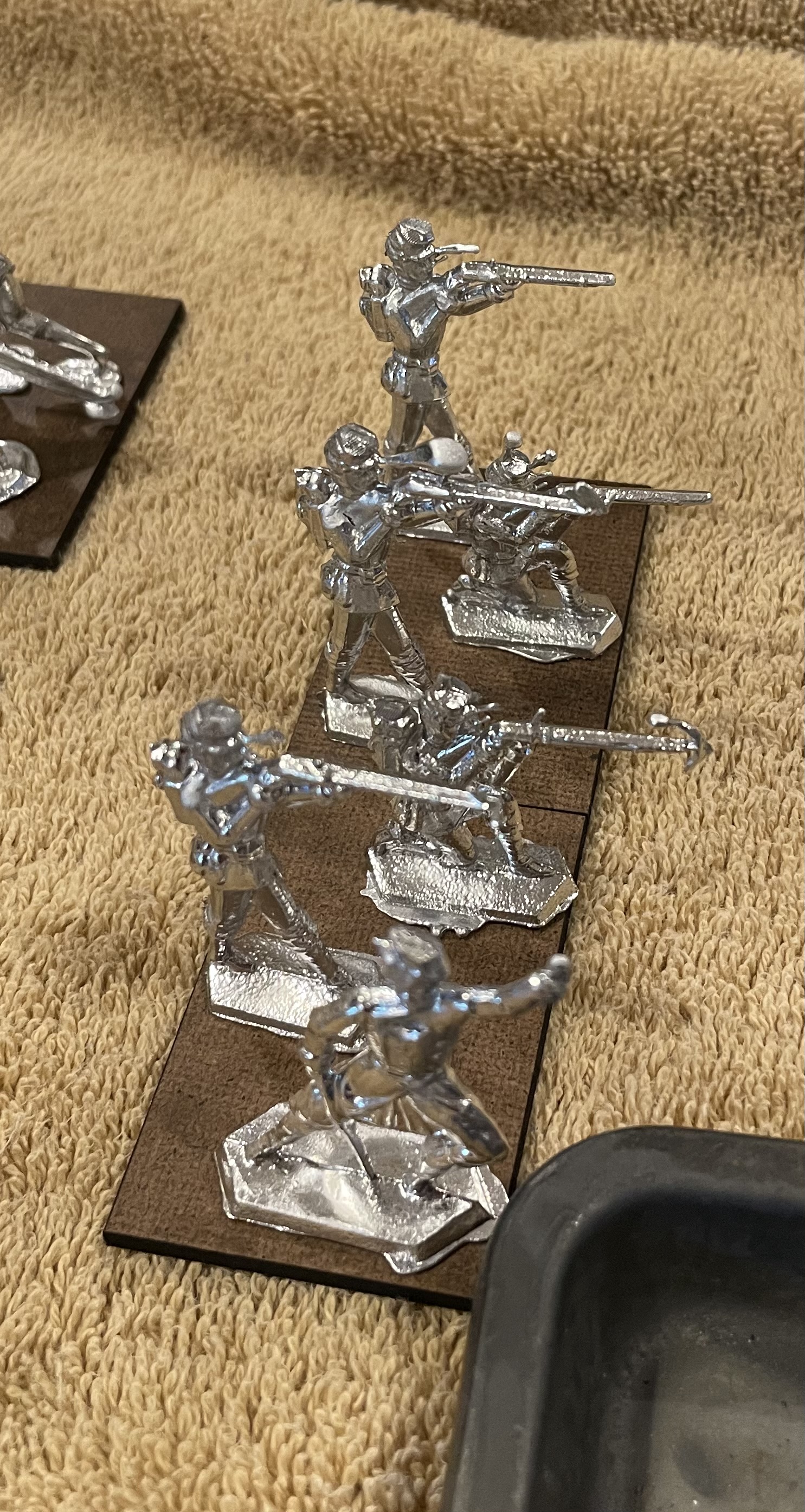
The infantry was generally casting well, particularly the standing and kneeling firing pairs, although some marching Prussians turned out to be rather fussy.  


With some figures cast in a previous experiment, three afternoons spent at this allowed me to cast enough figures for a French(ish) army and a Prussian(ish) army for One Hour Wargames, less one cavalry unit for each side. As can be seen in the basing mock-up picutres above, my plan is for each army to consist of 4 infantry units (each of 6 figures on 2 60x40mm bases), 2 skirmisher units (each of 4 figures on 2 60x60mm bases), 2 cavalry units (one only right now, consisting of 4 figures on 2 60x60mm bases),  and 2 artillery units (each of a cannon and 3 crew on a 60x80mm base). 

The Schneider mold series has a few “dramatic” figures.  I don’t yet know what I’ll do with the “falling wounded” or “clubbing with rifle” poses, for example.


Schneider had an extensive range of molds. (A link to their catalog can be found here.) I have some scenery molds, so while I was casting I decided to make a few more trees and try a sub-scale house mold I have.


As the fates will have it, the house proved remarkably easy to cast; I got three in three pours.  The tree mold is also very reliable.  I’m thinking for this project I’ll mount the trees on round bases and scatter a few over the cloth forest bases for appearance.  

My elder son gifted me with a grandchild last March, so we have been idly considering the proper age for involvement with our hobby.  Before that time, though, perhaps the Schneider molds could be used to produce a more pacific play set:


This is an assortment of Schneider farm animals, farm people, trees, and one of the houses (off in the distance with forced perspective 😆). The fence section is one of the cavities in the mold with the cow and the farm woman.  I also have a selection of Schneider zoo/wild animal molds.  I’d like to give them a try next time.  With the recent Not Quite Seven Years War games inspiring some work, I will probably need to haul out the gear sometime soon and fill out some partial units, so I don’t think it will too long before the next session.


Monday, January 16, 2023

Dean Con 2023

 Perhaps it wasn’t an “official” convention with a proper name, a program, and all of that, but I had the opportunity to get together with my sons for a two-day game gathering this weekend.  All three of us are employed by organizations that observe all federal holidays, so this was a three day weekend for all of us. That allowed us to seize the day(s).  We had been awaiting an opportunity to do so since younger son William arrived back in this general area in October.  Elder son Norman’s house was the obvious location, as he has been able to take over a finished basement room as his gaming and hobby space, with an adequate 5x6 foot table. 

Norman’s space, with the inevitable Really Useful Boxes neatly organized on shlves

As it worked out, we didn’t need the whole table, since the main program was a series of DBA games using various historical armies from our joint 1/72 scale plastic collection.  Norman had noted that we have at least 20 armies available to us at the moment, so he has decided to pit them against each other in an effort to determine which is the most powerful/successful.  He has divided them into four divisions of five armies each.  Each division will see each army play the others in a round robin format, with the two most successful armies in each division advancing to an elimination bracket tournament.  Some quick math will show that the divisional tournaments will consist of ten games each, and the final elimination will have three rounds of four, two, and one game respectively, for a grand total of 47 games.  This will not be a one-weekend effort.  Perhaps he will write something up about this eventually on his blog…

Between Saturday and Sunday, we completed the ten games of the first division.  Since William doesn’t own any of these armies, and Norman owns most of them, we tend to play somewhat objectively, and do not generally treat this as though it were a map campaign, with a strong personal identification with the fortunes of a particular army.  

Bronze Age Libyans face off against early Arameans

Once we had enough of DBA and needed a break, Norman set up a 19th century imagi-nations scenario.  We used (again) the rules in Neil Thomas’s book Wargaming Nineteenth Century Europe.  As with our Thanksgiving weekend, Norman chose one of the included historical scenarios, the battle of Oeversee from the Austrian/Danish War of 1864:


Neil Thomas is a proponent of fast, compact games.  This scenario is intended for a 2’ x 2’ space:


We had set it up on the 3’ by 3’ ground cloth we had been using for the DBA games before we looked closely at the scenario and concluded that the table was even smaller.  That’s how we ended up pulling a second ground cloth out of our ready supply of ground cloths and resetting. The town and bridge were provided by the usual toy soldier-appropriate Castle Blocks and the trees are from Norman’s old collection of 6mm scenery.  Wooden trees seen in some earlier battle reports are part of my collection of childhood toys, and weren’t part of what I was requested to bring.

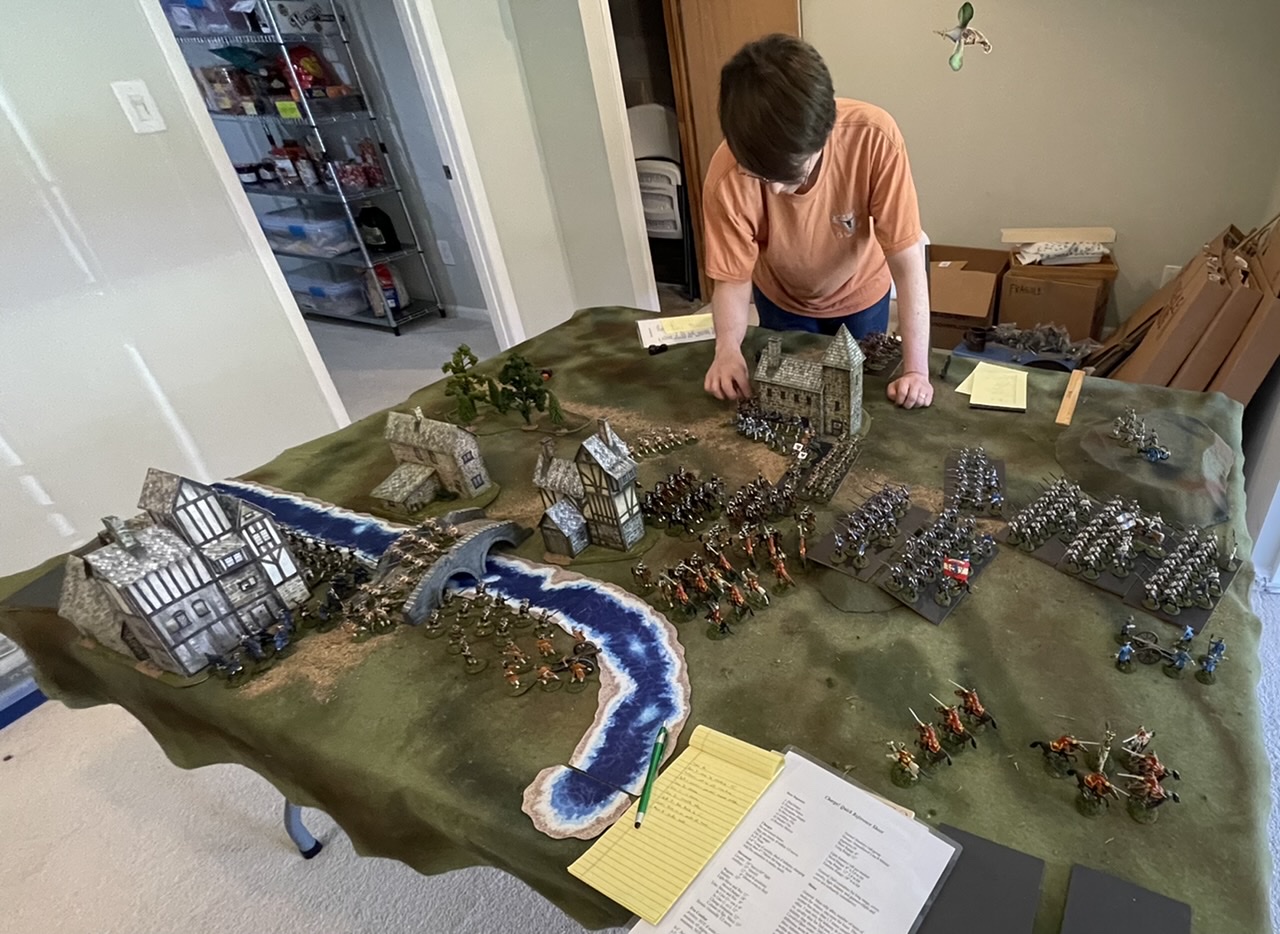
As can be seen from the set-up above, there was little room to maneuver.  The “Danish” forces, at the bottom of the picture and represented by Norman’s white-coated Elabruners were a rearguard.  Their orders were to hold the “Austrians” (represented by Norman’s Occiterrans) for ten turns to allow the remainder of their army, off-board, to retreat.  The Occiterrans were restricted by a doctrinal preference for the bayonet over firepower, but also started with their artillery deployed on a hill safely beyond a stream, and with the range to bombard the Elabrun infantry from the beginning.  William commanded the Occiterrans, and pushed aggressively forward, clearing the road in just six turns, so the game did not take long.


We had some supper, and spent the evening with some board games.  We played several rounds of 
Kingdomino, which I received as a gift from my parents at Christmas.  It’s a fast and engaging Eurogame, and I’m not surprised to find that it received the Game of the Year (Spiel des Jahres) award in 2017.  We also played a round of Azul.  We’ve been playing quite a bit of Azul on Board Games Arena, one of our favorite online hangouts since the plague, but this was the first time I actually played with a physical copy.

I will have a separate post soon about my recent revisitation of some 6mm projects.  I took my 6mm Hordes of the Things/DBA collection, handily contained in a large tackle box, with me this weekend.  On Sunday morning, Norman and I continued with the DBA 3.0 theme, but switched over to 6mm and pitted some early Franks against 3rd century Romans.


Both games were routs, one for the Romans, and then one for the Franks.  I have had the Roman fortress for many years (a TCS Model, now sadly no longer in business, but once a mainstay of the Historicon/Cold Wars dealers’ room), but I believe this may be the first time it has actually featured on the table as an active fort.  In any case, I enjoyed seeing the “little guys” out on the table.  They were most recently on the table as fantasy forces in an experimental playtest game we had at Huzzah in 2015, and, according to my records, were most recently deployed as actual ancients in May 2012, also at a Huzzah.  As I recall, that was also a test, of the Basic Impetus rules.  These figures used to be my usual portable set, and were therefore along at conventions as a contingency game.

Huzzah 2015 6mm fantasy playtest

I asked Norman this weekend whether he recalled how it was that we got away from this well-used project, a staple of my kids’ childhoods.  He noted that, to the best of his recollection, we started down the path of recreating a Hordes of the Things set up in 1/72 scale after he realized, while fiddling with the wargaming impedimenta around the house, that an Italeri Saracen was just the right size and shape to ride a plastic dinosaur from a Jurassic Park board game.  On such chances do the fortunes of our lives depend …

We closed out the weekend with a game of the popular board game Terraforming Mars, which took a little longer than we had estimated.  I look forward to a rematch, now that I have some slight idea of what I am trying to do. 

It was a good start to the gaming year, and I hope that we will be able to gather again soon, even if not for a two day extravaganza.


Monday, June 20, 2022

Battle at Gaithersbruck : A New Blog Post (?!)

 I decided to take a break from keeping up the blog earlier this year, and, if truth be told, I haven’t done much in the last few months that was particularly interesting. However, elder son Norman and I met yesterday to play a few games in his new basement gaming space. By his request, I brought down the Not Quite Seven Years War troops.  As is customary when  playing with just our own collection, though, the battle is set in the somewhat earlier War of the Western League (174x), rather than the actual NQSYW (175x).  All of last year’s NQSYW games were played with smaller units, using A Gentleman’s War or With MacDuff to the Frontier.  For this game, we returned to Charge! despite the limitation of using a 5x6 table. (I will note that Norman’s basement is big enough to deploy a 6x10 table, should we have four folding banquet tables available.)

I chose the scenario from C.S. Grant’s Scenarios for Wargames, as usual.  I have been gradually working through the ones that we have not yet tried, and I settle on scenario 20, “Reserve Demolition”.  This bears some resemblance to the Battle of Sittangbad in Charge!, although the actual Sittangbad scenario is more closely captured by Scenario 8 in Scenarios for All Ages, “The Vital Bridgehead”.  We used the usual proportions for scaling a C.S. Grant scenario to our 40s; about 2 scenario units per Charge! regiment. 

(North at the bottom of the overall picture below)


With the only sappers readily available to us being those of Schoeffen-Buschhagen, that cast the Pragmatic Coalition (S-B and Wachovia) in the role of the defender, attempting to withdraw their forces and demolish the bridge, and the Western League (Hesse-Hattemstadt, Schluesselbrett, and Saxe-Wiolenz) as the attackers.  Given that the last battle we saw in the War of the Western League resulted in a Coalition victory, forcing a river line on the road to Schluesselbrett, it would seem that the League forces managed a counterattack.

In accordance with the scenario book and the rules, we chose a 16 turn day, and diced for the arrival times of two approaching League columns.  As it happened, the first League column, composed entirely of native Schluessebrett troops, did not arrive on the scene until late morning (turn 6), about the same time that the sappers informed the local commander that the demolitions were in readiness. 

The first column was compelled to deploy under a galling fire from the small village at the crossroads, garrisoned by a detachment of converged S-B grenadiers, the Wachovian light infantry posted in the small wooded area west of the crossroads, and a battery of Wachovian artillery.  The cavalry swept around the defensive perimeter set up by the coalition, looking for a weakness.  


A freshly raised detachment of Schluesselbrett light infantry attempted to bring the village under fire, but were soon compelled to withdraw by heavy fire from the grenadiers.

The attacking infantry regiment was also quickly forced to withdraw.  

On the eastern flank of the Coalition perimeter the colonel of the Schluesselbrett dragoon regiment thought that he observed a gap in the Coalition defenses, and order his leading squadron to attack.  


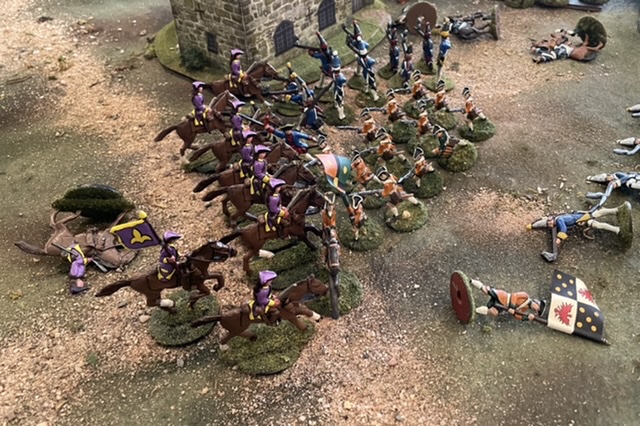
However, the S-B Prince’s Dragoon Guards were ready for them, and sounded the bugles for a charge of their own.  The typical sprawling cavalry melee, of charge and countercharge, with battered squadrons retiring to rally followed.  Fate (or skill) was not with the red-coats that day, as each of their attacks was thrown back in disorder by the Guards.  

As the cavalry battle developed, the Coalition commander (a Wachovian, it might be noted) took advantage of the lull in the western zone of the battlefield to begin withdrawing some of his forces.

Soon (~turn 9) the lagging second column of the League began to arrive by the eastern road, and started to push in the Coalition defenses.  The stolid Wachovian infantry and the S-B grenadiers held firm, but more League troops continued to arrive.  Clearly, this second column represented the main effort.  


It was now time to sound the retreat. 


However, as the remaining Wachovians formed up to cross the bridge, covered by the battered grenadiers, a squadron of League cavalry appeared from around the village and swept down on the infantry.


Seeing little chance that the remaining infantry could extricate themselves from the desperate fight in which they now found themselves, and with the League infantry pushing in steadily from the east, the Wachovian commander ordered the fuses to be lit on the bridge demolition charges.

With a tremendous explosion, the span of the bridge collapsed into the river, leaving the remaining S-B cavalry and grenadiers (as well as some of the Wachovian infantry) on the north (enemy) side of the river. Casualties were heavy on the Coalition side, but history records the action at Gaithersbruck as a Coalition victory, albeit a somewhat Pyrrhic one.  

There were probably stern letters exchanged between the higher commanders of the Coalition force, about the fact that the majority of the troops safely withdrawn were Wachovian, while the Schoeffen-Buschhagen elite troops were sacrificed in the rear guard action, but history records that the Coalition did not splinter over this incident.

It was good to get Charge! back on the table after a hiatus.  We were done by turn 14, having actually started at turn 6, so had nine turns of actual play, not unusual in our experience of the game.

Once we had that cleaned up, we played a couple of shorter games.


Norman pulled out his growing collection of 1/72 scale 19th century imagi-nations figures and we played the small battle scenario from Neil Thomas’s Wargaming Nineteenth Century Europe using the rules from the book.  Then we finished up for the day with a quick Bronze Age DBA game.

Over on the Tradgardland blog there has been discussion of old Schneider molds lately.  My other activity for the weekend was to try casting some of the ones I’ve acquired this past year.  It was a cool windy day, thouigh, so keeping the molds warm was difficult, and things weren’t too successful, unless you need a pine forest:


I hope the gun will work on a better day, as well as this interesting mold I have on an 18th century lady on horseback:


I hope the next post will be sooner than six months from now. 


Friday, June 28, 2019

A box of molds arrives

A new project

I really don’t need a new project, so, of course, I bought one.  A box with an assortment of Zinnbrigade molds for late 19th century Germans (and one SCAD mold for an 1870 French chasseur a pied) arrived yesterday.  Reading up on the French Revolution led to reading about the Paris Commune of 1871, which led to the Franco-Prussian War at large.  My son has been working on late 19th century imagi-nations in 1/72 plastic off and on for some time, but I have been planning for A Gentleman’s War in 40mm, so through the wonders of the Internet, an order was placed.  I will have to supplement with artillery from Irregular at least, and they may end up as my main source of FPW French.