Saturday, July 16, 2022

A Test of Army Painter Speed Paints with 1/72 Caesar Elves

 I’m usually a little behind the latest trends, so I finally picked up a few Army Painter Speed Paints for a trial.


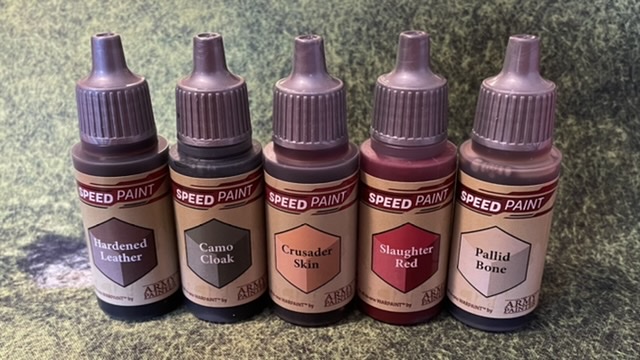
I picked up five colors from Critical Hit Games in Abingdon, Maryland.  I was actually expecting to do a test of some skeletons, so that’s why the pallid bone, and I’m honestly not sure why I chose red.  The brown and the green, I thought, would be a fair test for some “traditional” wood elves.

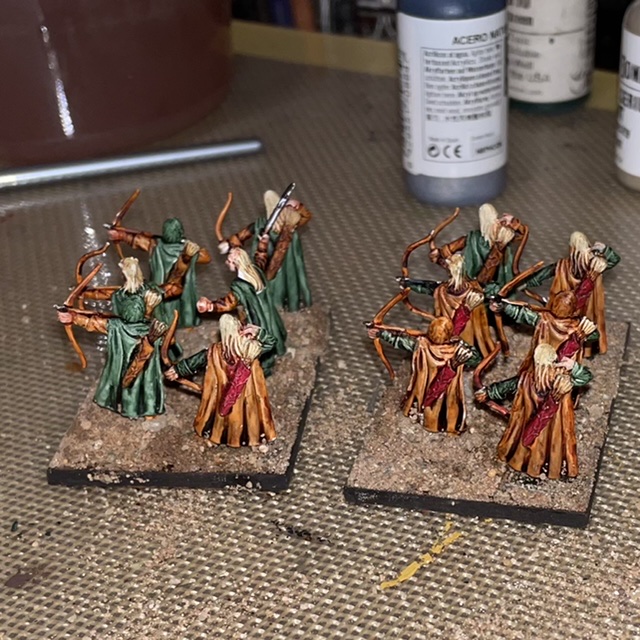
Since I would like to get an elvish army on the table as part of my plan for the Portable Fantasy Campaign, I pulled out a dozen 1/72 scale Caesar Elves earlier this week and washed them up as usual.  Yesterday after work I primed them with a Reaper brush on white primer, in keeping with the general instruction to use these over white.  I pulled out a cheap brush from a Dollar Tree craft section, which was unmarked, but about the size of a typical #2 round brush, since I didn’t want to risk any unforeseen side effects with a more expensive brush. I also pulled out an oatmeal container lid to use as a palette. I then queued up the latest episode of the Yarkshire Gamers Reet Big Wargames Podcast (which is appropriate because the host always asks guests what they think about contrast/speed paints), and started brushing.


Before the 1.5 hours podcast was over, I had paint on everything, with figures and sand on bases.  I did touch up some belts and metallics with conventional paints within that time block.  The Speed Paint seems to do a reasonable job of staying where you put it, so you can probably paint trousers first and a tunic after, if that made sense.  The one point that I should have considered before starting (but did not) is that the lighter colors do not cover darker colors.  Add that to the paint staying put once applied and it is clear that the correct order of application is “lightest to darkest” rather than “innermost to outermost” or “bottom to top”.  So I should have started will all “pallid bone”, then done the flesh tone, then the brown, red and green in any order that made sense.  That would have required me to consider the whole paint scheme first rather than starting (as I did) with the cloaks (because I knew what color I wanted them to be).  


I had not necessarily intended to paint figures entirely with Speed Paints.  If I had thought about this in advance, I would have bought one more neutral-ish brown or light green or something “elvish”.  Once I got started, though, I ended up “leaning in” to the speed aspect. As it was, half the figures got green tunics and brown cloaks (with the other half the opposite), half of the figures got pallid bone trousers and the other half got red, and the brown cloaks got red quivers while the green cloaks got hardened leather quivers.

I had a certain amount of touching up to do.  I usually paint over black primer so that a missed bit looks like a shadow, so I was not surprised to find that white primer with speed paints works about the same way as white primer with conventional paints.  I ended up tapping any white bits in out of the way places with the hardened leather, as being the most inconspicuous.

Once finished, I broke the figures off the craft sticks I use to handle them with (4 to a stick) and glued them to the movement stands with the usual Walthers Goo.  As soon as they had set enough to handle the base I added the usual mix of white glue and Nova Scotia traction sand to disguise the integral bases.  Since my white glue is fairly wet at that point, and since this was a speed test, I used a dropper bottle of water to wet the sand before it finished setting so that capillary action would pull enough glue to the surface to get some flock to stick.  In the interest of speed I did not add any additional small scatter (rocks, tufts, etc.) to the bases.

I then left them to dry overnight, and sprayed them with the usual Krylon Low Odor Matte Varnish I customarily use.  This does not appear to have had any adverse effects.


If you tap on the pictures, I have uploaded larger versions of them as usual, so that you may draw your own conclusions about whether this worked.  Keeping in mind that the whole purpose is to put tabletop quality units together quickly, it is to be expected that they are not optimized for close-up viewing.


Just for my own amusement, if I were trying to optimize 1/72 scale figures for closeup viewing, they would end up looking something like this sorceress and her guards I painted earlier this year (pre-basing…).

I decided to set them up next to some of the elves I did five or six years ago using my usual techniques.  Now, I will not that I did not really like the way these figures came out vis-a-vis how I had envisioned them.  They were done as regular speed paints, and I see that I skipped eyes and other fine detail not visible at table viewing distances.


And here is one stand of each with my elvish commander stand, which was painted as though each figure was intended to be viewed as an individual.


So, what’s the overall verdict?  I was pleasantly surprised to find that the Speed Paints seem to work as advertised, and, with a little more practice for the peculiarities of the paint, would allow you to throw some basic units on the table pretty quickly.  It’s probably worth getting a few more colors, and, just for fun, trying them out with some 25/28mm figures as well.


Friday, June 24, 2022

Information on Schneider Molds


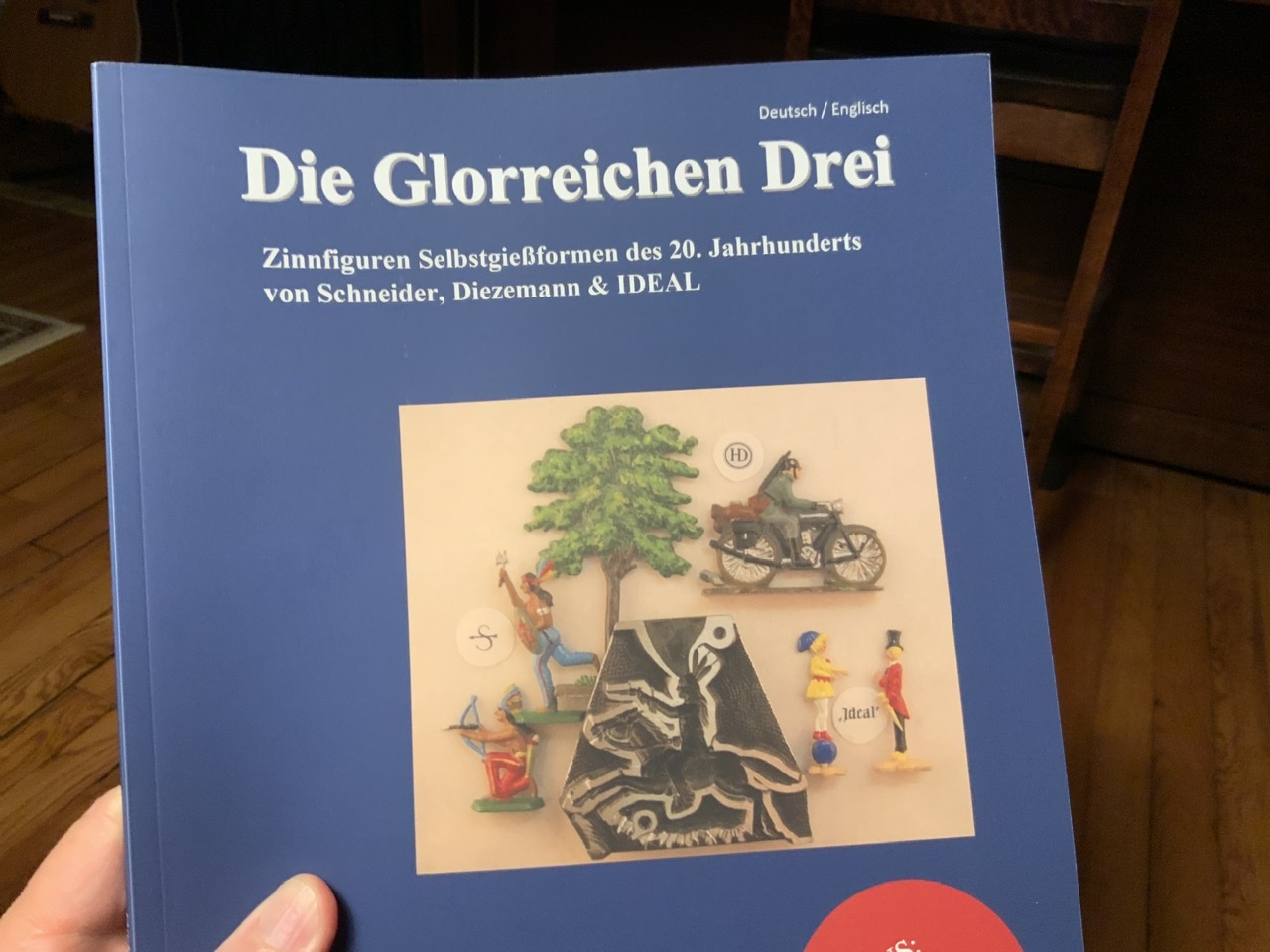
I really should know better than this, but I realized the other day that I might have more luck in finding some information on Schneider molds if I Googled in German.  (“Schneider Giessformen” …) In the process I discovered that this book was available through Amazon.  Since it is a print-on-demand, it came promptly, and even has a text (in smaller print) in English following the German.  I’m still absorbing it, but there is more information (and more molds…) out there than I had imagined.


Prompted by last week’s Not Quite Seven Years War game, I decided to return to the painting table, and dug out a partially completed unit I started working on sometime last year.  All the way back in 2011 (??!?) we acquired someone else’s partial imagi-nations project.  Most of the units have been rounded out, but there are still some partial units that have never been regularized and brough to the tabletop. These red coated troops will be a second regiment of infantry (or part of one, at least…) of the Archbishopric of Schluesselbrett when completed.


Monday, June 20, 2022

Battle at Gaithersbruck : A New Blog Post (?!)

 I decided to take a break from keeping up the blog earlier this year, and, if truth be told, I haven’t done much in the last few months that was particularly interesting. However, elder son Norman and I met yesterday to play a few games in his new basement gaming space. By his request, I brought down the Not Quite Seven Years War troops.  As is customary when  playing with just our own collection, though, the battle is set in the somewhat earlier War of the Western League (174x), rather than the actual NQSYW (175x).  All of last year’s NQSYW games were played with smaller units, using A Gentleman’s War or With MacDuff to the Frontier.  For this game, we returned to Charge! despite the limitation of using a 5x6 table. (I will note that Norman’s basement is big enough to deploy a 6x10 table, should we have four folding banquet tables available.)

I chose the scenario from C.S. Grant’s Scenarios for Wargames, as usual.  I have been gradually working through the ones that we have not yet tried, and I settle on scenario 20, “Reserve Demolition”.  This bears some resemblance to the Battle of Sittangbad in Charge!, although the actual Sittangbad scenario is more closely captured by Scenario 8 in Scenarios for All Ages, “The Vital Bridgehead”.  We used the usual proportions for scaling a C.S. Grant scenario to our 40s; about 2 scenario units per Charge! regiment. 

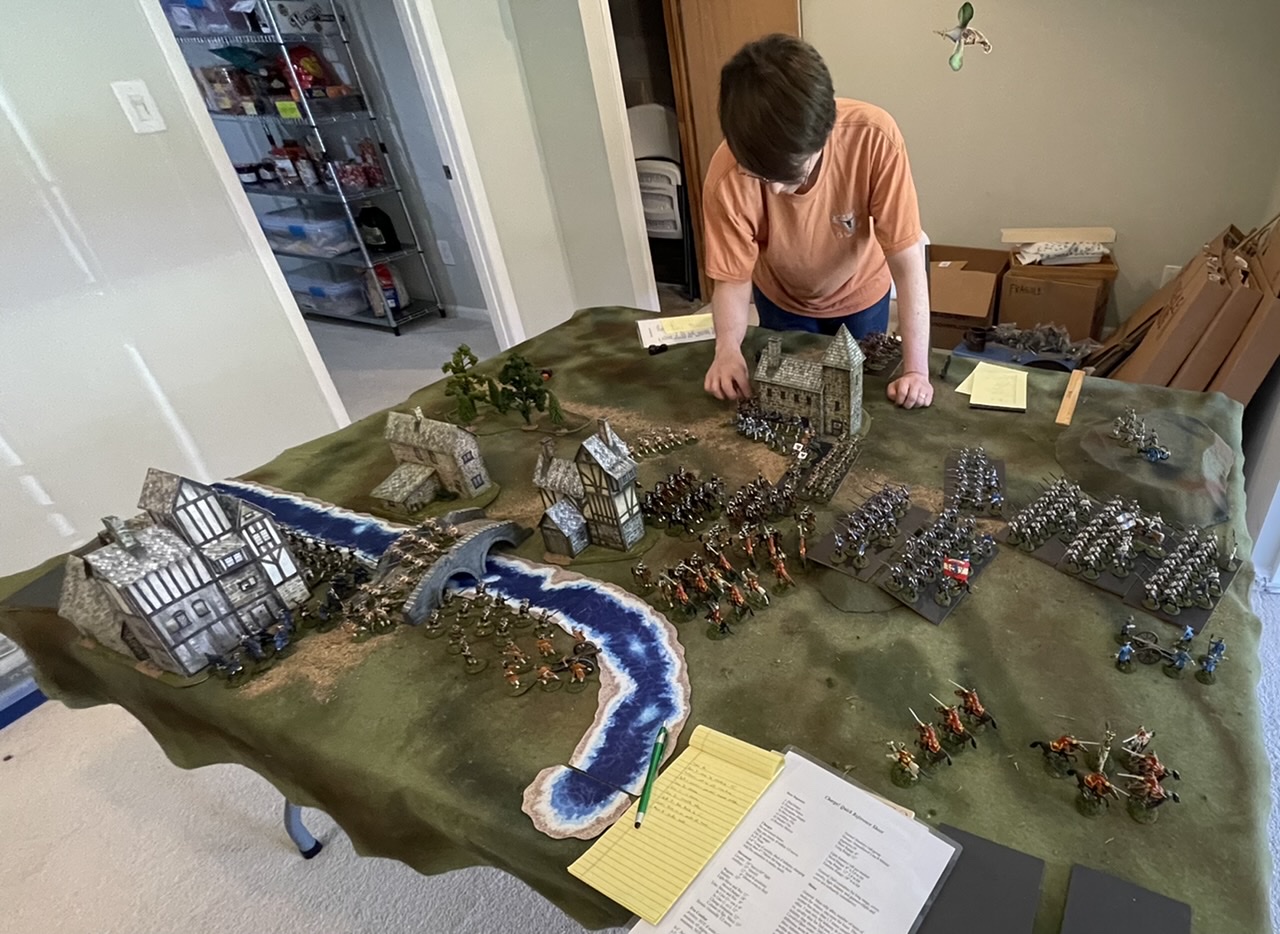
(North at the bottom of the overall picture below)


With the only sappers readily available to us being those of Schoeffen-Buschhagen, that cast the Pragmatic Coalition (S-B and Wachovia) in the role of the defender, attempting to withdraw their forces and demolish the bridge, and the Western League (Hesse-Hattemstadt, Schluesselbrett, and Saxe-Wiolenz) as the attackers.  Given that the last battle we saw in the War of the Western League resulted in a Coalition victory, forcing a river line on the road to Schluesselbrett, it would seem that the League forces managed a counterattack.

In accordance with the scenario book and the rules, we chose a 16 turn day, and diced for the arrival times of two approaching League columns.  As it happened, the first League column, composed entirely of native Schluessebrett troops, did not arrive on the scene until late morning (turn 6), about the same time that the sappers informed the local commander that the demolitions were in readiness. 

The first column was compelled to deploy under a galling fire from the small village at the crossroads, garrisoned by a detachment of converged S-B grenadiers, the Wachovian light infantry posted in the small wooded area west of the crossroads, and a battery of Wachovian artillery.  The cavalry swept around the defensive perimeter set up by the coalition, looking for a weakness.  


A freshly raised detachment of Schluesselbrett light infantry attempted to bring the village under fire, but were soon compelled to withdraw by heavy fire from the grenadiers.

The attacking infantry regiment was also quickly forced to withdraw.  

On the eastern flank of the Coalition perimeter the colonel of the Schluesselbrett dragoon regiment thought that he observed a gap in the Coalition defenses, and order his leading squadron to attack.  


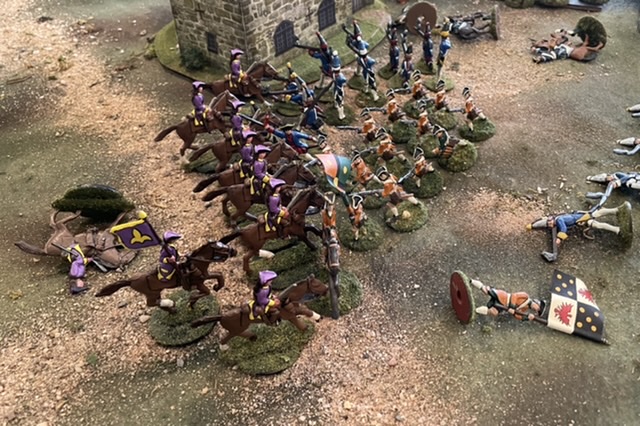
However, the S-B Prince’s Dragoon Guards were ready for them, and sounded the bugles for a charge of their own.  The typical sprawling cavalry melee, of charge and countercharge, with battered squadrons retiring to rally followed.  Fate (or skill) was not with the red-coats that day, as each of their attacks was thrown back in disorder by the Guards.  

As the cavalry battle developed, the Coalition commander (a Wachovian, it might be noted) took advantage of the lull in the western zone of the battlefield to begin withdrawing some of his forces.

Soon (~turn 9) the lagging second column of the League began to arrive by the eastern road, and started to push in the Coalition defenses.  The stolid Wachovian infantry and the S-B grenadiers held firm, but more League troops continued to arrive.  Clearly, this second column represented the main effort.  


It was now time to sound the retreat. 


However, as the remaining Wachovians formed up to cross the bridge, covered by the battered grenadiers, a squadron of League cavalry appeared from around the village and swept down on the infantry.


Seeing little chance that the remaining infantry could extricate themselves from the desperate fight in which they now found themselves, and with the League infantry pushing in steadily from the east, the Wachovian commander ordered the fuses to be lit on the bridge demolition charges.

With a tremendous explosion, the span of the bridge collapsed into the river, leaving the remaining S-B cavalry and grenadiers (as well as some of the Wachovian infantry) on the north (enemy) side of the river. Casualties were heavy on the Coalition side, but history records the action at Gaithersbruck as a Coalition victory, albeit a somewhat Pyrrhic one.  

There were probably stern letters exchanged between the higher commanders of the Coalition force, about the fact that the majority of the troops safely withdrawn were Wachovian, while the Schoeffen-Buschhagen elite troops were sacrificed in the rear guard action, but history records that the Coalition did not splinter over this incident.

It was good to get Charge! back on the table after a hiatus.  We were done by turn 14, having actually started at turn 6, so had nine turns of actual play, not unusual in our experience of the game.

Once we had that cleaned up, we played a couple of shorter games.


Norman pulled out his growing collection of 1/72 scale 19th century imagi-nations figures and we played the small battle scenario from Neil Thomas’s Wargaming Nineteenth Century Europe using the rules from the book.  Then we finished up for the day with a quick Bronze Age DBA game.

Over on the Tradgardland blog there has been discussion of old Schneider molds lately.  My other activity for the weekend was to try casting some of the ones I’ve acquired this past year.  It was a cool windy day, thouigh, so keeping the molds warm was difficult, and things weren’t too successful, unless you need a pine forest:


I hope the gun will work on a better day, as well as this interesting mold I have on an 18th century lady on horseback:


I hope the next post will be sooner than six months from now. 


Monday, January 24, 2022

Some thoughts on the hobby for 2022

 2021 was a bit of a slow year for gaming.  I am hoping to have a bit more fun in 2022, and have been thinking about what that might look like.

I have been trying to separate my desire for painting from any particular “get a game ready” goals, figuring that everything that gets painted will be used sooner or later, and there are enough periods and projects that are already “table-ready” to keep me pleasantly occupied painting.  That said, it would be nice to finish up the Bronze Age Nubian DBA army I started over the summer:


I would also like to add a few units (mostly specialized troop types) to the Not Quite Seven Years War. The last unit I added was an artillery piece and crew back in 2018 (or 2019 …).


  I started a group of six Prince August figures which are intended to be a light infantry detachment (for the reduced scale rules we have been using lately), but I’m still a painting session or two from finishing them.


I also have various 1/72 plastics ready to hand to fill roles in the Portable (solo) Fantasy Campaign, and a selection of vintage 25mm fantasy figures.  So whatever gets done will be good.  I had a nice string of “one figure per day on average” months, but it does look like January is going to be a break in that chain.

I did no casting in 2021, although I bought a fair number of used molds.  I would like to start casting again, when the weather is warm enough to work outside, and figure out which of the vintage Schneider molds will cast reliably.


That will allow me to decide whether I will be doing a mostly historical toy-style Franco-Prussian War project, a 19th century imagi-nations project, or neither.  I hope that this effort will resemble my 2020 project to cast from all of my old Prince August fantasy molds.  

As far as gaming goes, I have accumulated a stack of new rules that I would like to try.


I’ve also got a few older favorites (e.g. Knights and Magick) which I would like to dust off and get on the table.

I also have the ongoing solo fantasy campaign to play with, and am considering what it would take to put together a workable campaign on some sort. I suspect that the KISS principle needs to be kept firmly in mind…

I’m currently in a Dungeons and Dragons (5th edition) game, which has been running approximately biweekly.  I have posted a few things about my interest in reviving my original D&D campaign, so it seems likely that there will more RPGs this year.  

The elephant in the room, though, is downsizing.  I’ve accumulated more than I can reasonably expect to use, as each shiny new thing flashes in front of me and captivates me briefly.  Norm, over on his Battlefields and Warriors blog, has described his downsizing, and I need to take a serious look this year at what I can get done, and get some of the excess moved on to people who might be able to make use of it.  


Sunday, January 16, 2022

The Battle of Newkeep

There was a brief discussion this past week over on the Reaper Forums about solo games.  This reminded me that I had left a battle pending in the Northlands campaign.  Since the last Northlands related game I played was a skirmish game back in June, that probably means that it has been pending since some time in July or August.

So, I decided to set it up.  I had been avoiding it because it looked like a blow-out; one kingdom’s army had advanced into another’s territory, and, due to bad intelligence (as provided by occasional die rolls to assist in decision making along the way), was attempting to attack without realizing that they were outnumbered about 2:3.  But, having been reminded, I thought that I would like to resolve it, so as to clear the way for something more interesting down the line.  


I decided to roll at random for one of the 30 scenarios in Neil Thomas’s One Hour Wargames book, and got scenario 7, “Flank Attack”.  Not only that, but the dice decreed that the larger force was the ambusher.  I thought, “well, that’ll be that”, but then noticed one little peculiarity in the line up.  The smaller force (the King of Darmis and his army) had a Magician unit, and the larger force (the King of Verdance and his army) was led by a Hero (i.e. the King, in this case).  This being a full scale battle, the rules to be used were Hordes of the Things, and a Hero is particularly vulnerable to a Magician.  Hmmm…could be more balanced than it initially appeared, I thought.  I rolled a die to see whether the Verdancers were aware of the presence of the Magician, and they were not, so I set the King up to be boldly leading the flanking force.


The Darmish army is on the two hills at the bottom of the picture, facing down the road, and the Verdancers are on the hills by the tower and the edge by the woods, prepared to roll the Darmish up from the left flank.  To make this short, the battle lasted two turns (so two moves by each side).  The attackers rolled up the hill immediately destroying the unit on the left end, and pushing back the remainder.  This brought the King (Hero) within range of the the Magician (Cassara, the Blue Sorceress), and her side got enough activation points each of the two turns to move 1 unit and make one magical attack.  The second try succeeded, and, having lost 4 army points (in the form of the Hero/General) to 2 army points (one stand of bows), this amounted to “more and the commander” and the battle was over. Had the Verdance attack killed a second foot soldier unit on their second turn, it would have been 4 and 4 (i.e. not “more”) and the loss of the general would have been serious but not immediately fatal.  


This made a good solo game; if someone else had come over to play this, I would have felt bad about giving them either side, knowing from experience that it was going to be a pretty random thing as to whether the magic attack would succeed.


Since the actual game only took a few minutes, I decided that I would write it up in proper style.  Now it’s back to the map and notebook play, to finish out the campaign year’s record keeping, and figure out the next map moves.  With the capture of the King of Verdance, I suddenly have a need to know more about his family and possible factions within the kingdom.  

I also note that the campaign year included only two pitched battles, with the other one being the Battle of the Crossroads, which was fought all the way back in May 2019.  Both of these battles were ended when Cassara the Blue Sorceress took out the opposing general.  Perhaps the Blue Order will be looking for some increase in its standing within the Kingdom of Darmis as well?  I have considered the question of whether I might use this campaign map for a roleplaying game as well as a wargames campaign, and it is starting to look like adventure hooks just write themselves …

I am hoping that the second campaign year will move along a little more quickly than the first.  

Friday, January 7, 2022

Last Stand of 2021

As I mentioned before, I took a couple of hobby projects with me at Christmas, but ended up working on the maps rather than painting any miniatures.  December had already been a good month for miniatures, in the grand scheme of things.  However, after recovering from the trip, I wanted to get something done before the end of the year.  My desk was clean, so I decided I would use the travel paint kit to keep my choices down to a reasonable level, and inspire some creativity by accepting limitations.  I had one Strelets (006, Henry V’s Army) axeman in my travel miniatures box with a few colors on him, so I started off on the morning of the 31st by finishing him up.  After painting the last sorceress, I did a bit of quick ear surgery to turn a Caesar elf into a human, and that figure was also primed and ready to go, so finished up quickly.  

Hordes of the Things (and Dragon Rampant) are both very open-ended about what a stand might consist of.  I’ve done a couple of stands with two foot figures on them, and they look just a little thin to my eye, so I decided I would go for a third figure.  The archer is also from the Strelets set 006.  I had to stick him to a painting handle, prime him, let the primer dry, then paint.  In between I took a nap and played some online board games.  Before supper, all three figures got a layer of brush on varnish.  I pushed the basing a bit, handling things while still wet where I would ordinarily let things dry between steps.  


Nevertheless, what with staying up late to welcome the New Year and all, I was able to allow enough time for everything to dry and to put on the final spray varnish coat before I went to bed.  So, it went into my painting log as a 2021 accomplishment. So, there you have it, another Hordes Magician stand, bringing me to a total of 164 things (figures, buildings, and other scenery pieces) finished for the year.  This is the fourth year in a row with between 150 and 200 figures painted.  What that says about future projects is for another day…
 

Wednesday, December 29, 2021

A regional map for the Original D&D Campaign

 I showed off some of the material from my original D&D game back in April. While I had hoped to revive a D&D game this year, I ended up involved in a D&D 5th Edition game with a set of HAWKs players instead.  Nevertheless, I am still working toward actually doing this.

So, I took a few potential hobby projects with me, to fill any potential down-time during the family Christmas get-together.  Happily, there wasn’t a lot of that, but what time I did have I spent on drawing the Myzantine Empire map.

Since I was on a roll, I decided I would pull something off my D&D to-do list, and draw a more decorative map of the region in which the adventurers will be based.


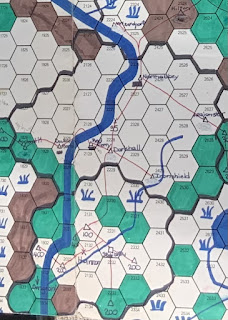
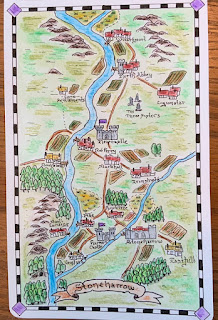
My original maps were drawn on SPI hex paper in the late 1970s, before I had done much reading in medieval demographics and agricultural history to get some sort of “realistic” grounding.  I ended up a little skewed (perhaps not inappropriate for a map which probably doesn’t owe much to surveyors), but attemtped to translate approximately the section above into a more fantasy style:


As with the Myzantine Empire, I added color with watercolor pencils, again deliberately keeping the colors somewhat less saturated.  I think this will do for a player handout … now I just need some players.